
How Many Sessions Will I Need? The Honest Guide for Job Seekers in Germany
Olha came to her first coaching session with one question: “Where do I even start?”
She had spent years working as a project manager back home. She had the experience, the skills, the drive. But after relocating to Germany, she felt stuck – uncertain about her prospects, unsure how to present herself, and quietly convinced that maybe her professional past didn’t count for much here.
She booked a single consultation. Then she came back for a full mentorship program. A few months later, she secured a position as a Project Coordinator in Germany – a role that matched her experience and her ambitions.
How many sessions did it take? Eight. But the number wasn’t really the point.
So: how many sessions will you need?
The direct answer: most clients find that 5–10 sessions are a strong starting point for lasting change. Single-issue topics – a specific interview, a CV review – can be resolved in 1–2 sessions. A full career transition or job search strategy in Germany typically takes 2–3 months of structured work.
But “how many sessions” is actually the wrong question. The right question is: what’s standing between you and the result you want? The number of sessions follows from that.
This article will help you figure out exactly where you are – and what it realistically takes to move forward on the German job market.
The Numbers Nobody Talks About
Before we get to session counts, here’s the context that makes everything else make sense.
As of mid-2025, around 373,900 Ukrainians are employed in Germany (Bundesagentur für Arbeit, 2026). That sounds like a lot – until you look at the other side of the picture: the unemployment rate among Ukrainian citizens in Germany sits at roughly 39% (June 2025, BA statistics). Almost half of those looking for work have experience in shortage occupations – fields where German employers are actively desperate for people.
The gap isn’t talent. The gap is visibility.
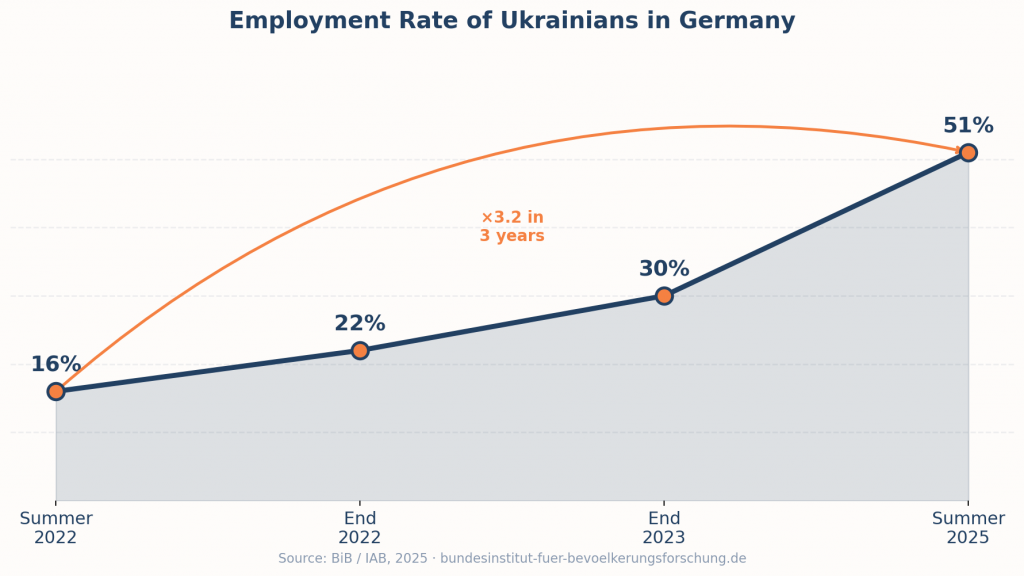
The employment rate among Ukrainians who arrived in early 2022 has tripled since then – from 16% in the summer of 2022 to 51% by summer 2025 (BiB/IAB, 2025). Progress is real. But it moves faster for people who understand how the German market actually works – and who have a strategy built for it.
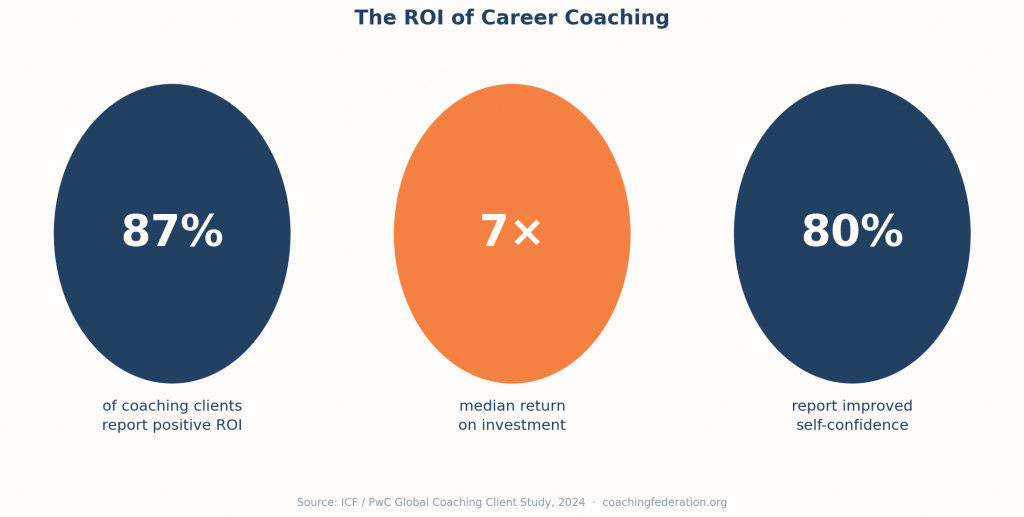
Meanwhile, the coaching industry backs up what these numbers suggest. Research by PwC and the International Coaching Federation found that 87% of coaching clients report positive ROI, with a median return of 7x the initial investment. 80% report improved self-confidence. 70% report measurable improvement in work performance (ICF/PwC, 2024).
That’s not motivation-poster data. That’s what happens when someone stops applying randomly and starts working with a clear, adapted strategy.
Why Germany Is a Different Game
The German job market is specific in ways that catch even experienced professionals off guard.
The Lebenslauf follows strict formatting conventions that differ significantly from CVs in other countries. Application documents are assessed differently – achievements matter more than responsibilities. The interview culture, the role of Anschreiben, the weight of Anerkennung (qualification recognition), the unspoken norms around professional communication – all of this is a learned system.
A migrant with 10 years of solid experience and a junior local candidate don’t start from the same position. That’s not a judgment – it’s a structural reality. And it directly affects how long the job search takes, and what kind of support actually helps.
Key insight: In Germany, job offers don’t go to the strongest candidates. They go to the most legible ones. The problem is rarely that you don’t have enough experience. The problem is that a hiring manager can’t quickly read what you bring to the table.
Good German and social connections are, according to the Bundesinstitut für Bevölkerungsforschung, “the key to integration.” Which is to say – the market is navigable. But it has to be navigated intentionally.
How Long Does the Search Actually Take? A Realistic Breakdown by Field
One of the most common frustrations job seekers face is a mismatch between expectations and reality. Here’s what the timeline actually looks like, broken down by professional profile:
| Profile | Realistic job search timeline |
|---|---|
| IT (developers, data, engineering) | 1–4 months |
| Marketing / HR / Sales | 3–8 months |
| Junior level / no German work experience | 6–12 months |
| Without German language skills | Add 2–4 months to any of the above |
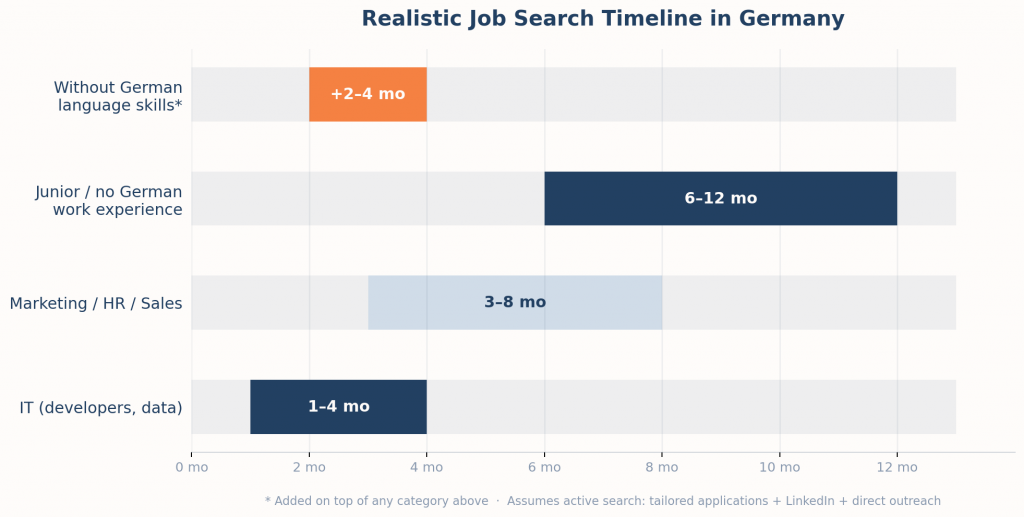
These are not pessimistic estimates – they’re what the data and client experience consistently show. And they assume an active search: tailored applications, LinkedIn engagement, direct outreach to hiring managers.
A passive search – sending generic CVs to job portals and waiting – can stretch these timelines indefinitely.
The Job Search Speed Formula
There’s a pattern behind every successful job search. It looks something like this:
Search speed = (Relevant applications × CV quality × Networking activity) / Uncertainty
Let’s unpack each variable — because each one is frequently misunderstood.
Relevant applications ≠ mass outreach. Sending 100 generic applications produces worse results than sending 20 carefully targeted ones. Quality of fit matters more than volume.
CV quality = not a document, but a sales tool. A Lebenslauf that lists responsibilities tells the employer what you did. A Lebenslauf that shows results tells them what you’re worth. These are very different documents — and most people submit the former thinking it’s the latter. Read the full guide on writing a German CV that actually gets you interviews →
Networking activity = LinkedIn, not just job portals. Most positions — especially qualified ones — are filled through networks before they’re ever publicly posted. Being visible on LinkedIn, engaging with people in your field, and writing directly to hiring managers is not aggressive. In Germany, it’s increasingly expected.
Uncertainty is the drag on everything else. Uncertainty about your professional direction, about how to present your experience, about what’s realistic — it slows every other part of the process down. This is where coaching most directly changes the equation.
Check Yourself: Is the Problem Really the Market?
Before concluding that the German job market is the obstacle, run through this checklist honestly:
✅ Are you sending 20–30 relevant, tailored applications per month?
✅ Do you adapt your CV for each specific vacancy?
✅ Do you write directly to hiring managers — not just apply through portals?
✅ Do you have an active LinkedIn strategy?
If two or more answers are “no” — the obstacle is not the market.
This isn’t a criticism. Most people simply weren’t taught to job search in Germany specifically. The rules here are different, and they’re not obvious from the outside.
Yuliia had been applying for months with a handful of rejections and fading confidence. After working on her documents and interview approach, she received four interview invitations — and a job offer at a public institution in Germany. The market hadn’t changed. Her strategy had.
Mistakes That Look Subtle But Cost You Everything
Not the obvious ones — everyone knows “have a good CV.” Here are the patterns that are harder to see from the inside:
❌ Translating experience instead of adapting it.
Describing your past role in German doesn’t mean you’ve adapted it for the German market. Employers here read for specific signals — achievement language, quantifiable outcomes, role-relevant framing. A direct translation preserves the content but loses the communication.
❌ Listing responsibilities instead of results.
“Responsible for managing a team of 8” tells an employer what your job description said. “Led a team of 8 to deliver a project 3 weeks ahead of schedule, reducing costs by 12%” tells them what you actually did. Every bullet point should answer: so what?
❌ Waiting to be discovered.
Many job seekers apply and wait. The German market — especially at the Fachkraft level and above — rewards proactivity. Direct outreach, informational conversations, referrals. Visibility has to be built, not hoped for.
❌ Ignoring ATS — and not knowing what it is.
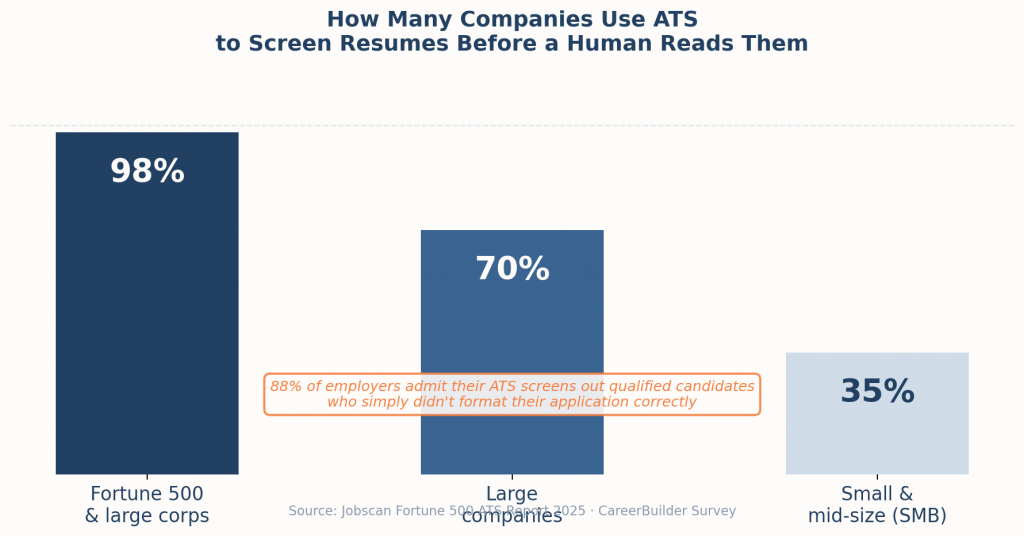
Around 98% of large corporations and 70% of bigger companies use Applicant Tracking Systems (ATS) to filter CVs before a human ever sees them (Jobscan/JobscanReport, 2025). Among smaller employers that number drops to roughly 35% — but in Germany, where medium and large Betriebe dominate qualified hiring, ATS is the norm, not the exception. What makes this particularly frustrating: 88% of employers themselves admit their ATS screens out qualified candidates who simply didn’t format their application correctly (CareerBuilder survey).
That means the first rejection you receive may not be from a recruiter — it may be from an algorithm.

Three rules that determine whether your CV makes it through:
No tables, text boxes, or columns. ATS systems parse text linearly. Complex layouts break the parsing, and your content disappears — even if the CV looks beautiful in PDF.
Use keywords from the job posting. The system matches your CV against the vacancy description. If the posting says “Projektmanagement” and your CV says “Projektleitung,” it may not register as a match. Mirror the exact language where possible.
Keep formatting simple. Standard fonts, clear section headers (Berufserfahrung, Ausbildung, Kenntnisse), no graphics, no icons, no photos embedded in tables. Readable by a human and a machine.
Yuliia’s documents weren’t just better — they were readable by the systems that stood between her and an interview. That’s a different skill set than writing well, and most people don’t know it’s required.
Honest Limitations (What Coaching Won’t Fix)

Most coaches don’t say this. Here it is anyway.
If you don’t have German language skills, the timeline will be longer. This is not a barrier to starting — it’s a variable in your strategy. Here’s how language level actually maps to opportunity in practice:
| German level | What it opens |
|---|---|
| B2 and above | Most office and professional roles — the full market |
| B1 | More limited choice; strong CV and positioning become even more critical |
| A2 or below | Specific niches only, or English-first companies and international environments |
This is not a reason to wait until your German is perfect before starting. But it is a reason to be realistic about which roles are within reach right now — and to build a strategy that accounts for where you actually are, not where you’d like to be.
Ukrainians who complete integration and language courses show significantly faster transitions into employment (BiB, 2025). Language investment is job search investment.

If you’re changing careers, treat it like a fresh start. A career pivot is not a job search – it’s a repositioning project. Your previous experience has value, but it needs to be reframed, supplemented, and re-presented almost from scratch. Tetiana came to coaching exhausted and without direction. After clarifying her competencies and identifying a new field, she didn’t just find a job – she started her own business and secured grant funding for it. That journey took more than five sessions. And it was worth every one.
If your activity level is low, coaching won’t compensate. A session gives you a strategy. The strategy only works when you act on it consistently. Coaching is a navigator – you still drive the car.
How Many Sessions, Really? By Request Type

Here’s the practical breakdown:
| What brings you in | What actually helps | Approximate sessions |
|---|---|---|
| One specific question (interview tomorrow, CV check) | Single Session | 1–2 |
| Job search in Germany – first time | Professional Package: Resume to Interview | 5 |
| Career reorientation – what do I do next? | Career Reorientation & Skills Assessment | 3 |
| Full job search support with strategy and accountability | Career Mentorship | 8 (over 2 months) |
| No cost through Jobcenter / Agentur für Arbeit | Career Orientation via Bildungsgutschein | Covered by voucher |
Christian arrived at a career crossroads, looking for direction. One session gave him new insight into both his professional situation and his personal priorities – plus a structured action plan. That was enough for what he needed.
Liliia had a biology background and no German work experience, with limited German. She completed a two-month mentorship program. She received two job offers and chose the best contract. She’s now working as a Biological-Technical Assistant in Germany.
Same coaching relationship. Very different needs. Very different processes.
Your First 30 Days: A Concrete Plan

The single most useful thing you can do at the start of a job search is structure the first month. Here’s what that looks like:
How much time does this actually take?
Expect to spend 15–25 hours per week on your job search if you want results within 2–4 months. That’s not a warning – it’s a calibration. A job search is a part-time job. People who treat it as something they’ll fit in around other things typically stretch their timelines by months. People who block dedicated time and work the process consistently get results faster than they expected.
If you’re currently employed and searching in parallel, 10–15 focused hours per week is a realistic floor. Less than that, and the search will stall.
Week 1 – Foundation
CV and positioning. Not “updating” your CV – rebuilding it as a sales document tailored to the German market. Defining your value proposition: what problem do you solve for an employer, and why you specifically? Full guide to the German CV here →
Week 2 – Volume with precision
20–30 tailored applications to specifically relevant vacancies. Not 100 generic ones. Each application adapted to the role – different CV framing where needed, a cover letter that answers the actual question behind the posting.
Week 3 – Network activation
LinkedIn profile optimized and active. Direct messages to hiring managers at target companies. Engagement with content in your field. This is not self-promotion – it’s professional visibility, and it’s expected.
Week 4 – Calibration
First interview invitations or feedback loop. What’s working, what isn’t. Adjust the strategy based on real signals rather than assumptions. This is often where the most important coaching work happens.
What Six Months of Ineffective Job Search Actually Costs
This is the conversation most people avoid having with themselves.
Six months of applying without a strategy isn’t just frustrating – it has a measurable cost. Not getting the job is only part of it.
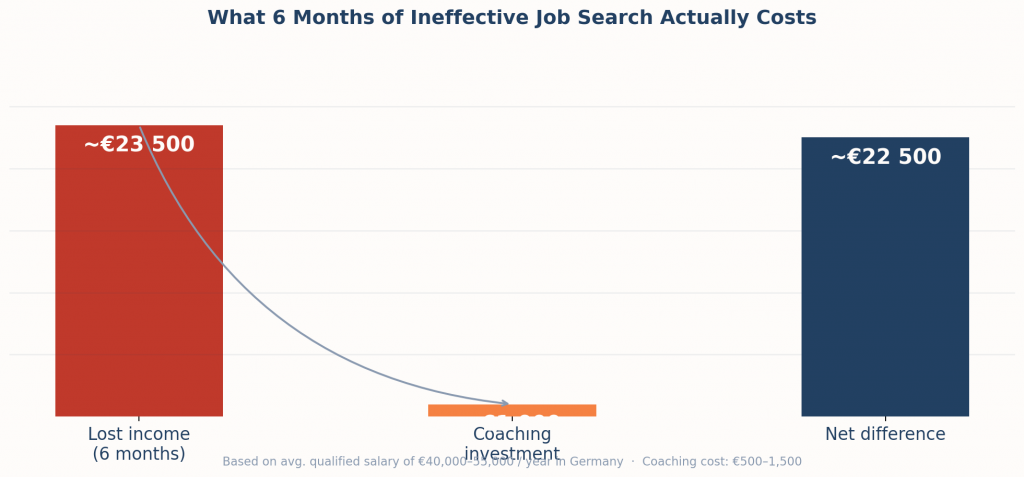
Lost income. At an average qualified salary in Germany of €40,000–€55,000 per year, six months of unemployment means €20,000–€27,000 in foregone earnings. Even if coaching costs €500–€1,500, the math is not complicated.
Lost confidence. Rejection is cumulative. Every week without a response, every silence after an interview, chips away at how you present yourself — in applications, in interviews, in conversations with contacts. Confidence is not separate from the job search. It’s part of the product you’re selling.
Worse positioning over time. This one is rarely discussed. A CV gap grows. Skills drift further from market expectations. Your most recent role becomes less recent. The longer the search runs without results, the harder the next application becomes. Momentum works in both directions.
The goal of coaching isn’t to shorten your job search by a few weeks. It’s to prevent the kind of six-month drift that costs far more than any coaching program.
Bildungsgutschein: When Coaching Costs You Nothing
If you’re registered with the Jobcenter or Agentur für Arbeit in Germany, you may be eligible for the Bildungsgutschein – an educational voucher that covers the full cost of approved coaching and career programs.
This means the question “can I afford coaching?” may not be the right question at all. The voucher is issued by your case worker and covers a structured program – including career orientation, CV preparation, job search strategy, and interview coaching.
More than half of the Ukrainians who successfully transitioned into employment in Germany did so after completing integration and language programs (BiB, 2025). Structured support works. The question is whether you use it.
Full guide to Bildungsgutschein for career coaching in Germany →
One Insight That Changes Everything
Here it is – the thing that reframes the whole conversation:
The problem is rarely that you don’t have enough experience. The problem is that the employer can’t read your experience quickly enough.
Hiring managers in Germany spend an average of 30–60 seconds on an initial CV scan. In that window, they’re not evaluating your full professional history – they’re pattern-matching against a mental model of what the right candidate looks like. If your documents don’t match that model – even if your actual experience is a perfect fit – you don’t get the call.
This is why Olha felt stuck despite being genuinely qualified. This is why Yuliia was getting rejections before getting four interview invitations from the same quality of applications – just restructured. The market didn’t change. The signal did.
Coaching doesn’t make you more qualified. It makes you more legible.
The Anti-Insight: Why More Applications Is Often the Wrong Answer
Here’s something that runs counter to most job search advice:
Sending more applications is usually not the solution. It’s often the reason you’re stuck.
When a strategy isn’t working, the instinct is to scale it – send more CVs, apply to more portals, spend more hours searching. But if the underlying approach is flawed, more volume produces more rejection. And more rejection produces less confidence. And less confidence produces worse applications. It’s a loop, not a strategy.
Most job seekers in Germany don’t fail because they’re underqualified. They fail because they’re applying like it’s 2010 – mass outreach to job portals, generic documents, passive waiting.
The German market in 2025 rewards precision over volume. A week spent rebuilding your CV from scratch, activating two LinkedIn conversations, and sending eight carefully targeted applications will consistently outperform a month of spray-and-pray applications.
The problem isn’t effort. It’s direction.
FAQ
Is there a guarantee I’ll find a job after coaching?
No – and anyone who promises that is not being honest with you. Coaching provides strategy, tools, and clarity. Results depend on your consistency and activity. What coaching does guarantee is that you’ll have a significantly clearer picture of what to do and why.
What if one session is enough for me?
Sometimes it is. Christian resolved his career direction question in a single session. The Single Session format exists precisely for people with a specific, focused question. Start with the free 20-minute introductory call – it often becomes clear very quickly what format fits your situation.
How much time should I leave between sessions?
Typically 1–2 weeks. That gap is working time – applications sent, conversations had, documents revised. Without that, the next session has nothing to build on. Coaching without action between sessions is just conversation.
Can I start coaching without a clear goal?
Yes, and this is actually very common. Many clients come in knowing something feels wrong but not yet able to name it. The first session – which is free – helps clarify the actual question. You don’t need to arrive with answers. You need to arrive willing to work.
I still have a job but feel it’s time to change. Is coaching relevant for me?
This is often the best moment to start. You have time to think strategically rather than reactively. Tetiana came to coaching before a crisis – she was simply exhausted and without direction. She left with clarity, a plan, and eventually a business with grant funding. The best time to build a map is before you’re lost.
Is coaching in Germany covered by the Bildungsgutschein?
It can be. If you are registered with the Jobcenter or Bundesagentur für Arbeit, your case worker can issue a voucher that covers an approved coaching program at no cost to you. See the full guide here →
Ready to Find Out What You Actually Need?
The first session is free. 20 minutes. No pressure, no commitment – just a conversation about where you are and what moving forward could look like.
Most people leave that call with more clarity than they arrived with. That’s usually enough to know whether coaching is the right next step.
Sasha Osypenko is a career and integration coach who helps professionals with a migration background navigate the German job market. She supports clients with CV strategy, job search structure, and interview preparation in English, German, and Ukrainian.
