How to Write a German CV (Lebenslauf), That Actually Gets You Interviews
March 29, 2026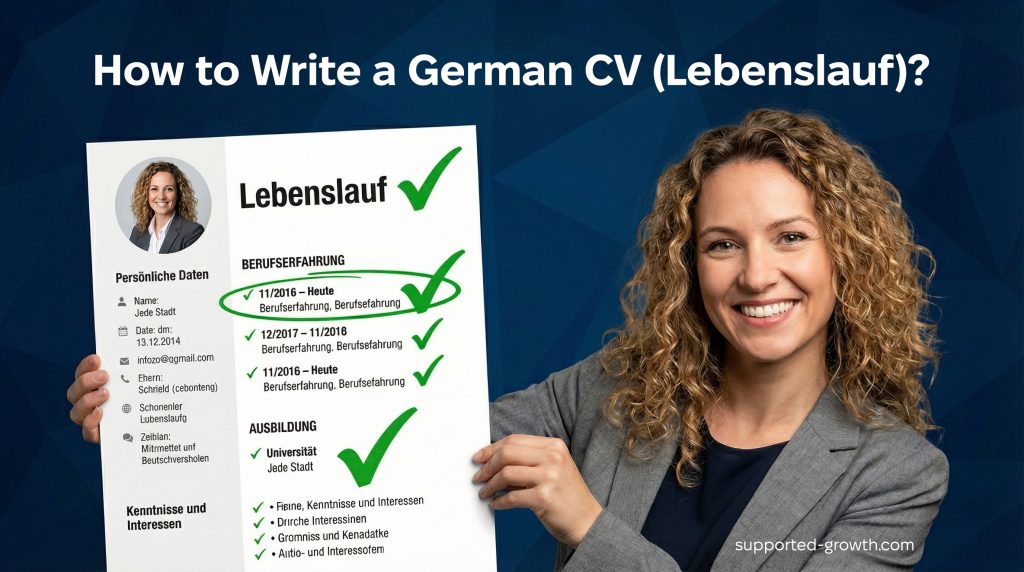
Olena spent three months sending CVs across Germany. She had seven years of experience as a financial analyst. Her German was B2. She applied to over 40 positions – mid-level roles, nothing out of reach. The response rate was close to zero.
When she finally got feedback from a recruiter, it came in two sentences: “Your background is interesting, but your application documents don’t meet German standards. We encourage you to revise them and reapply.”
She had no idea what that meant.
If you’ve been in a similar situation – or you’re about to start your job search in Germany and want to avoid it – this guide is for you. We’ll walk through exactly what German employers expect when they open your CV, what immediately signals “this person doesn’t know our market,” and how to present your experience so it lands.
How a German CV (Lebenslauf) Differs From What You’re Used To
If you’ve worked in Ukraine, the UK, or most other European countries, your first instinct will be to adapt your existing CV. Resist it. The German Lebenslauf follows its own conventions – and deviating from them, even slightly, creates friction with the person reading your application.
Here’s what makes it different:
A professional photo is expected. In many countries, adding a photo to your CV is discouraged or even illegal (as a protection against discrimination). In Germany, it remains standard practice. The photo should be a professional headshot — ideally taken by a photographer — against a neutral background. Not a cropped group photo, not a selfie, not a passport-style image with a white background and a stamp.
Personal details go at the top. Date of birth, nationality, marital status, and sometimes even your address — all of this is normal to include in a German CV. It feels intrusive if you’re used to anonymous applications, but German HR departments are accustomed to it and often expect it.
A Deckblatt (cover page) is optional but appreciated. Larger companies and more formal industries (law, finance, public sector) often see a separate cover page as a sign of professionalism. It typically includes your photo, name, contact details, and the position you’re applying for – formatted cleanly, one page.
A handwritten signature is still a thing. Many German employers – particularly in traditional industries and public institutions – expect you to sign your CV at the bottom. In practice, this means signing a printout, scanning it, and attaching it as a PDF. Or using a digital signature tool. It signals attention to formality.
The tone is factual, not narrative. German CVs read like structured records, not personal stories. No “I am a results-driven professional with a passion for…” The facts speak for themselves. Your job is to organise them clearly.
The Structure of a German Lebenslauf, Section by Section
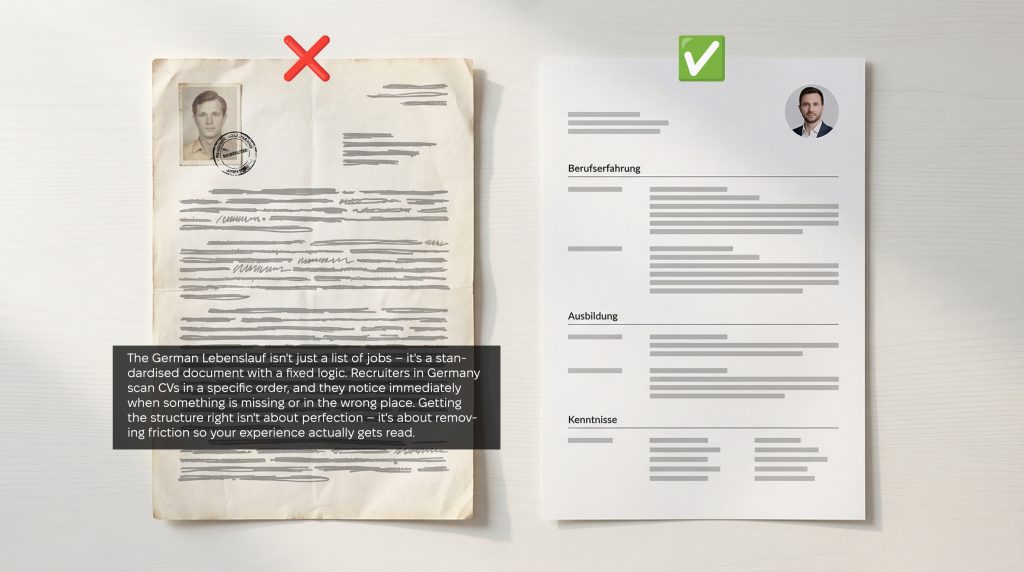
The standard German CV follows a fixed order. Deviating from it – even if your alternative looks cleaner – signals that you don’t know the local conventions. Stick to this structure and spend your energy on the content within it.
Persönliche Daten (Personal Details)
This goes at the very top, either alongside your photo or directly below it.
What to include: full name, date of birth, place of birth (optional but common), nationality, address, phone number, email, and LinkedIn profile if it’s up to date.
What to skip: you don’t need to include your nationality if you’d rather not, and marital status is increasingly optional in younger industries.
Berufserfahrung (Work Experience)
This is the core of your CV. List your positions in reverse chronological order – most recent first. For each role, include:
• Job title (in German, if the role had a German equivalent)
• Company name and location
• Start and end dates (month and year)
• 3–5 bullet points describing your responsibilities and, where possible, your achievements
Dates are formatted as MM/YYYY – for example, 03/2021 – 11/2023. If you’re currently employed, write seit 03/2024 (since March 2024) or simply 03/2024 – heute (today).
Ausbildung (Education)
Also in reverse chronological order. Include the degree, institution, location, and dates. If you studied outside Germany, include the German equivalent of your degree in parentheses – for example, Bachelorabschluss (entspricht B.Sc.).
If you have a university degree, you don’t need to list your secondary school unless it’s particularly relevant.
Weiterbildungen (Continuing Education)
Courses, certifications, professional training – list them here. This section matters more than many people realise. German employers value structured professional development, and a relevant certification can compensate for gaps in direct experience.
Kenntnisse (Skills)
This section covers languages, IT skills, and any other technical competencies. Use a simple, honest rating system for languages:
| Language | Level | German equivalent |
|---|---|---|
| Native | Mother tongue | Muttersprache |
| C2 | Full proficiency | Verhandlungssicher |
| C1 | Advanced | Fließend |
| B2 | Upper-intermediate | Gute Kenntnisse |
| B1 | Intermediate | Grundkenntnisse |
| A2 | Elementary | Basiskenntnisse |
Do not inflate your language levels. German recruiters frequently conduct initial screening calls, and if your spoken German doesn’t match what’s on your CV, it ends the process immediately.
For software and tools, stick to what’s relevant to the position and describe your level simply: Grundkenntnisse, Gute Kenntnisse, or Sehr gute Kenntnisse.
Interessen (Interests)
This section is optional and increasingly skipped. Include it only if your interests are genuinely relevant to the role or reveal something meaningful – volunteering, a language you’re learning, a technical hobby. Avoid generic entries like “travelling” or “reading.”
7 Mistakes That Send Your CV Straight to the Bin
These are the errors that cause German recruiters to stop reading – often within 30 seconds. Most of them are specific to candidates with international backgrounds.
1. Translating your Ukrainian CV word for word. The structure, length, and tone of a Ukrainian CV are different. Running your existing CV through DeepL and calling it done produces something that reads awkwardly in German — and often includes formatting that doesn’t match local expectations. Start from scratch using the German structure above.
2. Using an informal or inappropriate photo. A cropped photo from a birthday party, a selfie with a filter, or a very formal official photo with an institutional stamp — all of these create a poor first impression. The standard is a clean, professional headshot. If you don’t have one, it’s worth investing €50–80 in a session with a photographer.
3. Describing duties instead of contributions. “Responsible for managing client accounts” tells a recruiter almost nothing. “Managed a portfolio of 45 B2B clients, increasing retention rate from 74% to 89% over 18 months” tells them something real. Wherever you can, replace duty descriptions with measurable outcomes.
4. Listing short-term positions without context. Several roles of 2–4 months in a row will raise immediate questions. If they were project-based contracts, say so explicitly: Projektvertrag (project contract) or Zeitarbeit (temporary employment). If there were personal reasons for leaving, you don’t need to explain on the CV — but prepare to address it in the interview.
5. Leaving employment gaps unexplained. A gap of 3+ months will be noticed. You don’t need a lot of detail – a line like Elternzeit (parental leave), Weiterbildung (professional development), or Relocation nach Deutschland (relocation to Germany) is enough to prevent a recruiter from drawing their own conclusions.
6. Overstating your German level. This comes up constantly with candidates from Ukraine and other non-German-speaking countries. If your German is B2, write B2. If it’s B1 with active study, write B1 and note that you’re enrolled in a language course. Honesty here saves everyone time – including yours.
7. Sending a file that isn’t a PDF. Word documents can render differently across systems, and track changes can be accidentally left on. Always export your CV as a PDF before sending. Name the file clearly: Lebenslauf_Vorname_Nachname.pdf.
Not sure if your CV meets German standards? Book a free 20-minute session with Sasha — she’ll tell you exactly what’s working, what isn’t, and what to fix before you send your next application.
The Invisible Filter: How ATS Systems Screen Your CV Before a Human Sees It
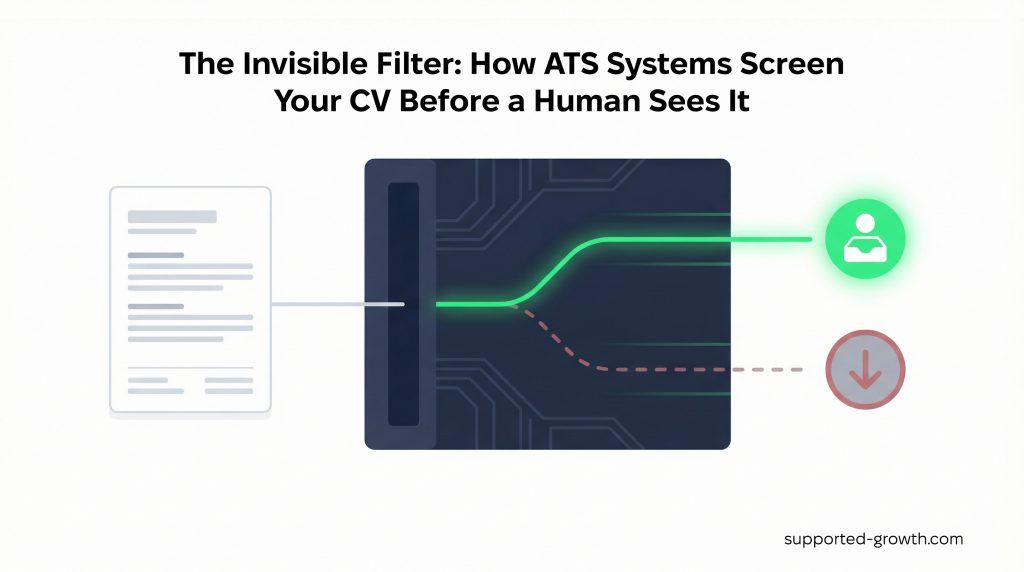
Most large German employers – corporations like Siemens, Bosch, and Deutsche Telekom, hospital networks, public sector organisations, and many mid-sized companies – use Applicant Tracking Systems (ATS) to process incoming applications. These are software platforms that scan CVs automatically, looking for specific keywords before a human recruiter ever opens the document.
If your CV doesn’t contain the right terms, it may never reach a person.
This matters particularly for candidates with foreign-language backgrounds. If the job posting asks for “Projektmanagement” and your CV says “project management” or “управління проектами”, the ATS may not connect the two – even if your experience is directly relevant.
How to work with ATS rather than against it:
Read the job posting carefully and identify the key terms – both the role title and the specific skills and tools mentioned. Mirror that language in your CV, particularly in the skills and work experience sections. If the posting says “agiles Projektmanagement”, use that exact phrase.
At the same time, don’t stuff your CV with keywords at the expense of readability. ATS systems have become more sophisticated, and human reviewers still read what passes through. Your CV needs to work for both.
Formatting that confuses ATS:
• Tables used to structure the layout
• Text in text boxes or graphics
• Headers and footers used for substantive content
• Unusual fonts or heavy graphic design
Simple, clean formatting – standard fonts, clear section headings, text in the main body – performs best with ATS and human readers alike.
How to Present Foreign Experience to a German Employer
This is where many strong candidates lose ground – not because their experience isn’t valuable, but because German HR teams don’t have the context to understand it.
A recruiter in Munich may not know what a “провідний спеціаліст відділу маркетингу” means, whether the company you worked for is large or small, or how your university in Kharkiv compares to German institutions. Your job is to provide that context – concisely and without overselling.
Translate your job title into its German equivalent. Look at how similar roles are described in German job postings. If you were a Senior Marketing Specialist in Ukraine, the closest German equivalent might be Senior Marketing Manager or Referent Marketing. Use the German convention.
Add a brief descriptor after your company name. One line of context goes a long way:
DTEK Energy, Kyiv – einer der größten privaten Energieversorger der Ukraine (ca. 70.000 Mitarbeiter)
Now the recruiter knows they’re looking at a large, significant employer – not a local agency with five people.
Describe your work in terms of scope and scale. Budget managed, team size, number of clients, revenue generated, geographic reach. These are universally understood metrics that give your experience weight regardless of whether the recruiter knows your industry or country.
Address your relocation directly. If you relocated to Germany from Ukraine – whether due to the war or for professional reasons – you can note it briefly in your CV, either in the personal details section or in a short introductory profile paragraph. It explains timeline gaps and demonstrates adaptability, which German employers value.
Pre-Send Checklist: 12 Things to Verify Before You Hit Send
Use this before every application.
| # | Check |
|---|---|
| 1 | CV is saved as a PDF, named Lebenslauf_Vorname_Nachname.pdf |
| 2 | Professional photo included (unless the company explicitly says no photo) |
| 3 | All dates formatted as MM/YYYY |
| 4 | Reverse chronological order throughout |
| 5 | No employment gap longer than 3 months left unexplained |
| 6 | Language levels are honest and match actual ability |
| 7 | Key terms from the job posting appear in the CV |
| 8 | No tables, text boxes, or graphics that could confuse ATS |
| 9 | CV is no longer than 2 pages (1 page for under 5 years of experience) |
| 10 | Signature included at the bottom (either handwritten-scanned or digital) |
| 11 | Email address is professional (firstname.lastname@, not nicknames) |
| 12 | CV has been read aloud once to catch awkward phrasing |
Which Tool Should You Use to Build Your German CV?
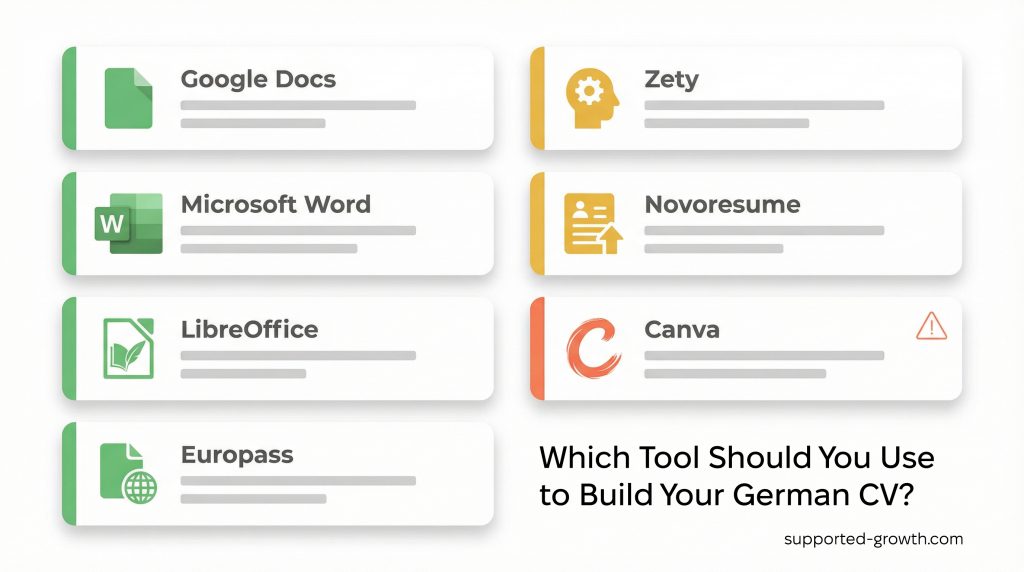
This is where a lot of candidates make a hidden mistake. They open Canva, find a beautiful Lebenslauf template, spend two hours getting the layout right – and then send a file that an ATS system can’t read at all. The result is zero response and no idea why.
Before looking at design or features, ask one question first: will this CV pass automated screening? That narrows the choice quickly.
| Tool | Free / Paid | Pros | Cons |
|---|---|---|---|
| Google Docs | Free | ATS-safe, shareable link for feedback, exports clean PDF, Lebenslauf templates in gallery | Slightly limited formatting control |
| Microsoft Word | Paid (Office 365) | Full formatting control, ATS-safe, widely accepted, .docx is the industry standard | Costs money; rendering varies if recipient opens in different software |
| LibreOffice Writer | Free | Free Word alternative, outputs .docx, ATS-safe | Interface feels dated; fewer templates |
| Europass (cv.europa.eu) | Free | Standardised EU format, fully ATS-safe, recognised across all EU member states | Rigid structure, no design flexibility |
| Zety | Free preview / Paid to download | Guided prompts help beginners, ATS-optimised templates, built-in content suggestions | Full download requires subscription; English-first |
| Novoresume | Free (1 CV) / Paid | Clean ATS-friendly templates, good for international companies | Limited German-specific templates; free tier is restricted |
| Canva | Free (limited) / Paid | Beautiful Lebenslauf Vorlagen, very easy to use, great visual results | ⚠️ ATS risk — graphic-heavy PDFs are often unreadable by automated systems |
Why Canva needs a separate warning
Canva’s Lebenslauf templates genuinely look professional, and the editor is fast and intuitive. The problem is structural: Canva builds CVs as layered graphics. Text placed inside columns, decorative frames, or text boxes often can’t be extracted by ATS software. The recruiter’s system may see a blank document – or scramble your sections entirely.
Use Canva if you’re applying to creative roles (graphic designer, art director, photographer), design agencies, or small start-ups that review every CV manually. In these contexts, a visually distinctive CV can actually work in your favour.
Avoid Canva if you’re applying to large corporations, public sector organisations, hospitals, banks, or any company running applications through SAP SuccessFactors, Workday, or Taleo. The risk of your CV disappearing into a black hole is real.
The practical recommendation for most job seekers
Start with Google Docs. Open the template gallery, search “Lebenslauf,” and pick a clean single-column layout. It’s free, produces ATS-safe PDFs, and you can share the link directly with a coach or a trusted contact for feedback before sending. For most people in Germany’s job market, this is enough.
If you’re applying to public sector, hospital, or EU institution roles specifically, switch to Europass – it’s the expected format and removes all formatting uncertainty.
One thing no tool can do for you
Every builder gives you a structure. None of them knows your experience, your strengths, or how to frame a career transition in a way that lands with a German recruiter. That part – turning your background into a compelling document – is where a coaching conversation makes the real difference.
Ready to Move Forward?
Writing a strong German CV takes time – and getting it right the first time matters more than most people realise. Each application is a chance that’s hard to get back once you’ve been rejected.
If you’d like a professional to review your documents before you send them, Sasha Osypenko offers a free 20-minute session where you can discuss your specific situation, get direct feedback on your CV, and understand what your next steps should be.
No commitment, no sales pitch. Just a clear picture of where you stand.
Frequently Asked Questions
➤ How long should a German CV be?
For candidates with up to five years of experience: one page. For candidates with more than five years: two pages is the standard. Three pages or more is only appropriate for senior academic or executive roles. German recruiters are accustomed to concise, structured CVs – longer does not mean more impressive.
➤ Is a photo on a German CV required?
It’s not legally required, but it remains the strong norm. Most German job postings don’t mention the photo because it’s assumed. Omitting it won’t automatically disqualify you, but including a professional photo signals familiarity with local conventions. If you’re applying to international companies or start-ups, you can skip it – they tend to follow more global standards.
➤ Do I need a cover letter (Anschreiben) in Germany?
Yes, in most cases. The cover letter is a separate document that explains why you’re applying to this specific company for this specific role, and what you bring that makes you the right fit. Unlike the CV, it should have a personal tone. Many candidates underestimate it – a well-written Anschreiben can compensate for gaps in experience; a weak one can undermine a strong CV.
➤ How do I handle employment gaps on a German CV?
Briefly and honestly. A line is enough: Elternzeit, Pflege eines Familienmitglieds, Weiterbildung, Krankheit, or Relocation. German employers are generally understanding about gaps that have a clear explanation. What creates concern is a gap with no explanation at all – it invites assumptions.
➤ Should I include references on my German CV?
No. German CVs don’t include references or the phrase “references available upon request.” Employers who want references will ask for them specifically, usually at a later stage of the process.
➤ Can I use an English CV to apply for jobs in Germany?
It depends on the company. International corporations, tech companies, and start-ups often accept English-language applications. For German companies, public sector roles, or any position where German is the working language, a German CV is expected. When in doubt, submit in German – it demonstrates commitment and language ability at the same time.
➤ What German CV format works best for career changers?
The standard reverse-chronological format is still the default. However, if you’re making a significant career shift and your most recent experience doesn’t reflect your target direction, you can add a short professional profile paragraph at the top (3–4 sentences) that frames your transferable skills and explains the transition. Functional CVs – which organise experience by skill rather than by date – are rarely used in Germany and can raise questions.
➤ My degree is from a Ukrainian university. How do I list it?
List it as you normally would, with the full name of the institution, the degree title, and the dates. You can add a parenthetical note with the German equivalent: Nationaler Bergbau-Universität Dnipro, Ukraine — Abschluss: Diplom-Ingenieur (entspricht M.Sc. Maschinenbau). If your qualification has been officially recognised in Germany through anabin or KMK, note that too.
Sasha Osypenko is a career and integration coach working with professionals who have a migration background. She helps clients navigate the German job market – from application documents to interview preparation – in German, English, and Ukrainian.