
Why Are You Rejected After Job Interviews? From Analysis to Strategy
March 7, 2026Rejection after an interview is often perceived as a personal failure. But let’s shift the paradigm: an interview is not an exam to determine whether you’re a “good person,” it’s a business puzzle alignment. It’s a check for a match between the company’s needs, the team’s chemistry, and your professional strategy.
If the puzzle didn’t come together, it doesn’t mean you’re “bad”. It simply means that a systemic gap appeared somewhere. Let’s take a look at where exactly it might be hiding.
The Gap Between the “Paper” and the “Word”
A résumé (CV) opens the door, but it’s the interview that actually sells you. Often, the problem is that the candidate doesn’t know how to “ground” their achievements in concrete terms.
| What Not to Do (Abstraction) | What to Do (Specifics) |
| “Optimized processes in the department” | “Implemented a CRM system, which reduced the sales cycle from 14 to 9 days” |
| “Increased efficiency by 25%” | “By automating reporting, saved 10 hours per week for 5 employees” |
Why This Matters: The interviewer is looking for evidence of your independence. If you can’t break down your results into details (Situation → Task → Action → Result), confidence in the numbers on your résumé drops.
Example: A candidate for a Project Manager position. In the résumé it says: “Successfully managed cross-functional teams”.
- • In the interview: When asked to describe a conflict within the team, the candidate says: “We just sat down, talked, and everything worked out. I try to maintain a friendly atmosphere”.
- • Where it failed: The interviewer doesn’t see the tools or methods used.
- • How it should be: “I noticed a conflict between development and design due to unclear requirements (Situation). I introduced a joint task grooming stage (Action), which reduced rework by 30% (Result)”.
The “Universal Soldier” Trap
Many people think flexibility is a strength. In reality, employers need clarity.
Mistake: “I can do marketing, sales, and also manage projects”.
Diagnosis: Lack of focus. Companies need a specialist for a specific “pain point,” not a jack-of-all-trades who will get bored tomorrow and move to another field.
Advice: Clear positioning is not self-limitation — it’s a sign of professional maturity. The more precisely you focus on one point, the higher your value.
Example:
A candidate for a Data Analyst role.
- • In the interview: When asked about career goals, the candidate replies: “I just like numbers, but I can also manage people, and if needed I can write Python code and boost sales. I learn fast — I’m interested in everything”.
- • Where it failed: To the employer, this sounds like: “I don’t really know what I want, and I might leave in three months when I find something more interesting”.
- • How it should be: “My focus is product analytics. I want to work deeply with retention metrics, as this is my strongest skill”.
The Architecture of Your Answer
They evaluate not only your experience, but also how you think. If your answers are chaotic, the interviewer concludes: “He or she will work just as chaotically”.
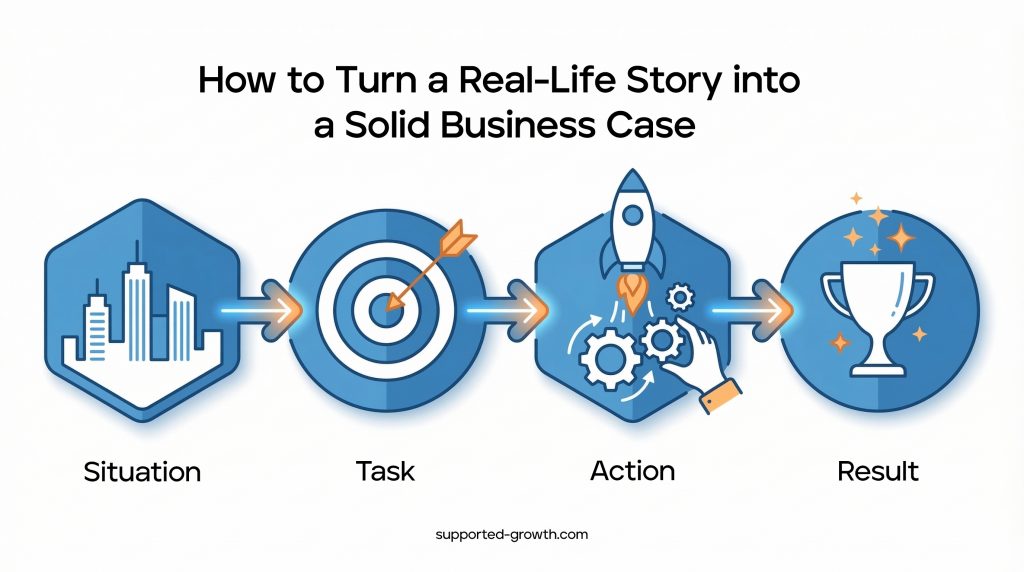
The Gold Standard for Answers (The STAR Method):
- 1. S (Situation): What context were you in?
- 2. T (Task): What problem were you facing?
- 3. A (Action): What exactly did you do? (Avoid using “we”.)
- 4. R (Result): What was the outcome in numbers or facts?
This is critically important when relocating. In Western cultures, a direct, structured style is valued. A modest “we tried and it worked out” sounds like a lack of personal contribution there.
Example:
Question: “Tell us about your biggest mistake”.
- • Unstructured answer:
“Once we launched an ad with a broken link. It was terrible, we wasted the budget, the manager was shouting, but then we fixed everything and never did it again”. - • Answer according to the STAR method:
- • • (S): During the launch of a $50K campaign, the link was broken.
- • • (T): The goal was to stop the budget from being wasted and minimize losses.
- • • (A): I set up an automated link-checking script within 20 minutes and negotiated with the platform for compensation of the impressions.
- • • (R): Recovered 15% of the budget.
Conclusion: A checklist review is now a mandatory step.
Energy and Market Context

Work is not only about hard skills, but also about the ability to “carry” the workload.
Energy Level: If you appear burned out, the employer may worry that you won’t be able to keep up the pace. Calm confidence is the result of preparation, not an innate gift.
Cultural Code: Every country has its own “rules of the game”. In some places, you need to be an assertive leader; in others, an empathetic team player. Failure to align with this code is often perceived as “not a good fit”.
Example:
A specialist from Eastern Europe is interviewing with a German or American company.
- • Situation: When asked, “Why should we hire you?”, the candidate replies modestly: “I just do my job well. My results speak for themselves — everything is in my résumé”.
- • Where it failed: In the U.S., this can be perceived as a lack of leadership and confidence. In Germany, it may be seen as a lack of clear structure in self-presentation.
- • How it should be: “I studied your expansion into the LATAM market. My experience launching similar products can save you two months in the strategy adaptation phase”.
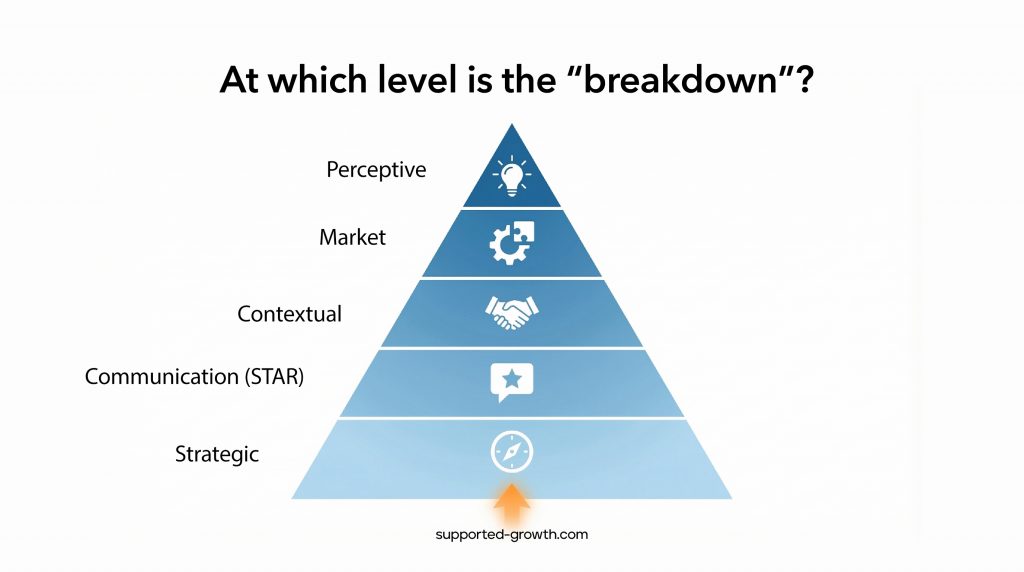
Matrix of Possible Reasons for Rejection
| Level | Problem | What to Check |
| Strategic | Lack of Focus | Is Your Target Role Clear Within 30 Seconds? |
| Communication-Related | Too Few Facts | Do Your Answers Follow the STAR Structure? |
| Contextual | Mismatch in Style | Is your communication tailored to the culture of the company or country? |
| Market-Related | Experience Gap | Do you meet at least 70% of the requirements? |
| Perception-Related | Doubts | Does your voice convey confidence in your value? |
Example:
A Head of Sales position in an international startup.
- • Situation: The candidate has outstanding experience in local retail (15 years) and is a “star” in that market. However, the startup operates on a SaaS subscription model for a global market.
- • Where it failed: The candidate is strong, but they lack experience with metrics like LTV/Churn and working with remote teams across different time zones.
- • Result: The rejection happened not because they are a poor manager, but because the company currently doesn’t have the time to train them in the specifics of the IT market.
What Is the Interviewer Actually Hearing?
When you talk about the past, the employer is trying to predict the future:
- 1. Relevance: Has this person solved similar tasks before?
- 2. Thinking: Do they demonstrate cause-and-effect reasoning?
- 3. Accountability: Do they take ownership of results, or just go with the flow?
- 4. Potential: Can they grow within the company over the next year?
Example:
Question: “How do you feel about overtime?”
- • The candidate thinks: They want to know whether I’m ready to work 24/7.
- • The interviewer is actually checking: Whether the person can set boundaries and manage their time.
- • Bad answer: “Yes, of course — I live at work!” (What they hear: “I will burn out quickly”.)
- • Good answer: “During product launches, I’m ready to give maximum effort. In regular operations, I build processes so the team can complete everything within working hours”.
Through the Eyes of the Employer: Hidden Filters
When you talk about your experience, the interviewer filters your words through four lenses:
- • Test for “Did” vs. “Participated”: The employer is looking for individual contribution. If you constantly say “we,” they hear: “I was a passenger in this project”.
- • Logic and Critical Thinking: It’s not just about solving the task — it’s about how you analyzed it. Do you demonstrate cause-and-effect reasoning?
- • Cultural Code and Soft Skills: The interviewer subconsciously evaluates your fit with the team. “Can I work with this person under stress?” “Will they disrupt the team’s atmosphere?”
- • Long-Term Potential: The company invests significant money in hiring and onboarding you. It needs to see your growth potential so the investment pays off.
An interview is not a knowledge test (that’s what assignments are for), but an assessment of how you will solve the company’s problems tomorrow.
Checklist: What to Do If You Were Rejected?
Don’t fall into self-blame. Turn the rejection into a source of data:
- • [ ] Request feedback. Even a formal response can highlight a skills gap.
- • [ ] Audit your answers. Record your responses. Do they sound logical and structured?
- • [ ] Review your positioning. Are you casting your net too wide?
- • [ ] Assess your mindset. Did you go into the meeting as a partner or as a petitioner?
Harvard Business Review: 6 Red Flags That Stop Even Great Candidates From Getting Hired
Source: hbr.org / October 3, 2025 / Authors: Boris Groysberg and Robin Abrahams
Sometimes, rejection has nothing to do with your professional competence. Even if your resume is perfect and your experience aligns, certain behavioral cues can trigger an instant “no” from recruiters. A study of over 350 senior executives identified six recurring red flags that derail otherwise qualified candidates.
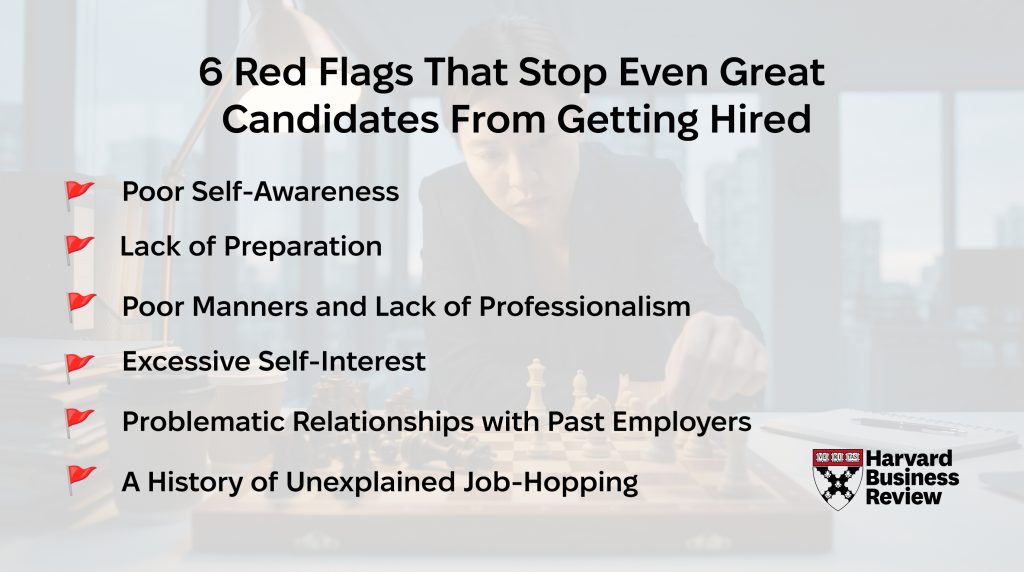
The 6 Red Flags to Avoid:
- 1. Poor Self-Awareness The most common deal-breaker. Candidates who struggle to describe their own blind spots or failures come across as immature. Employers look for “confident humility”—the ability to own your mistakes and show a willingness to learn.
- 2. Lack of Preparation Failing to research the company’s products or being unable to describe the specific role you applied for signals a lack of genuine interest. In the age of instant information, basic curiosity is the most reliable signal of your potential.
- 3. Poor Manners and Lack of Professionalism Especially critical in a hybrid world. Lateness, inappropriate virtual backgrounds, or being overly informal are seen as signs of disregard. Professionalism is about showing respect for the interviewer’s time and the company’s culture.
- 4. Excessive Self-Interest While discussing compensation is necessary, leading with it is a mistake. Focusing entirely on “what’s in it for me” (salary, perks, vacation) makes you appear transactional rather than curious about the work itself.
- 5. Problematic Relationships with Past Employers Criticizing former bosses or colleagues is a major warning sign. It suggests you may have issues with authority, a lack of discretion, or an inability to take responsibility for your part in professional conflicts.
- 6. A History of Unexplained Job-Hopping Frequent, short-term stints without a clear, logical explanation make you look like a “flight risk.” Companies invest heavily in onboarding and want to see evidence that you are a reliable, long-term bet.
The Role of a Career Coach
If rejections have become a pattern, it means you have a “blind spot”. A coach helps you:
- • Separate facts from emotions: A rejection doesn’t mean you’re “bad” — it means the strategy didn’t work.
- • Rehearse the interview: See yourself from the outside and remove chaos from your speech.
- • Adapt to the market: Align your presentation with local standards (especially when relocating).
Mini-Diagnosis: 5 Control Questions
- 1. Can I explain in one minute what value I will bring to this specific company?
- 2. Do I have 3–5 prepared cases structured as (Problem–Solution–Result)?
- 3. Does my experience truly cover 70–80% of the job requirements?
- 4. Do I project confidence, or am I waiting to be “evaluated”?
- 5. Do I understand the cultural specifics of this employer?
If you answered “No” to at least two questions, your strategy needs adjustment.
Do you want to turn your next rejection into an offer?
Analyzing your own mistakes alone often feels like trying to see your ears without a mirror. You can keep refining your résumé endlessly, yet still fail to notice a “blind spot” in your communication or positioning.
Book a free 20-minute diagnostic session to:
- • Identify the “failure point”: We will analyze your recent interviews and determine at which level (strategic, market-related, or communication-related) the breakdown is happening.
- • Review your main case: We will break down one of your answers using the STAR method to make it sound compelling to employers.
- • Align your focus: We will ensure that your positioning matches what the market is currently looking for.
Just 20 minutes to stop guessing “why not me” and start taking control of the hiring process.
