Career Change: Why You’re Stuck – and How to Finally See What You Really Want
April 14, 2026
You work. You function. But inside you feel empty, blocked, or simply not in the right place. You know something is off – and yet everything stays the same.
Maybe you think: “It’ll get better eventually.” Or: “I don’t even know what I’d do instead.” This article will help you understand what truly drives you – and why you haven’t acted yet.
That’s exactly the story of John – the protagonist in John Strelecky’s bestseller “The Café on the Edge of the World”. An overworked manager who just wants a short vacation to gain some distance. Who takes a wrong turn. And who, in a small café in the middle of nowhere, encounters questions he has been running from his entire life. The book has been translated into over 40 languages – not because it’s complicated, but because millions of readers have recognized themselves in it. Perhaps you will too.
What the Numbers Say: You Are Not Alone
Professional dissatisfaction is not a personal failure – it is a widespread phenomenon that recent studies clearly confirm.
| 77% | of employees in Germany have low emotional attachment to their employer |
| 13% | have no emotional attachment at all – inner resignation |
| 37% | are actively looking for a new job or open to a change |
Source: Gallup Engagement Index Germany 2025
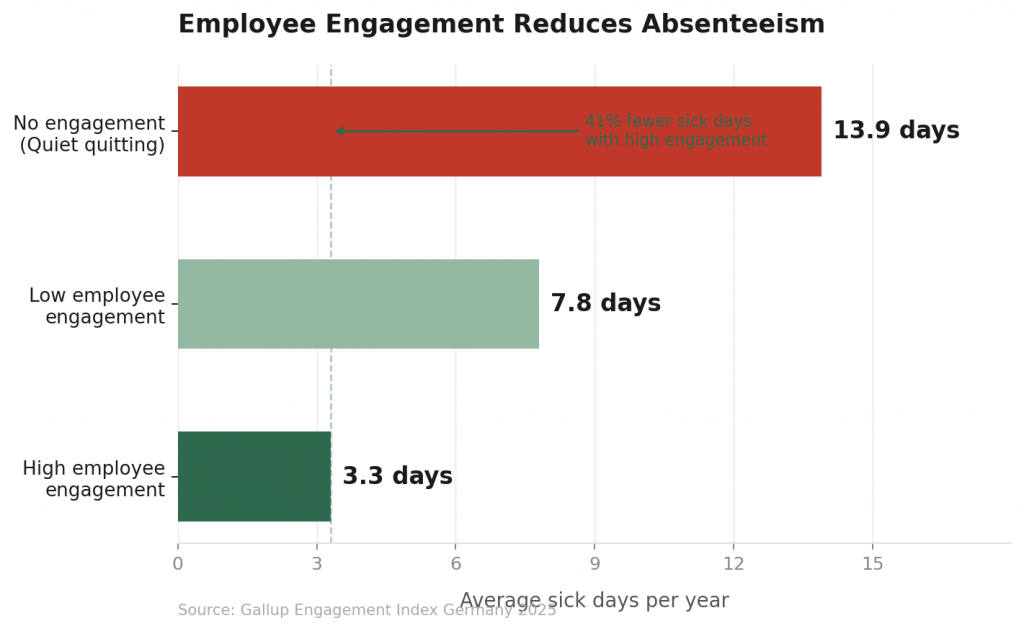
At the same time, only 10% feel highly emotionally connected to their company. The downward trend has stopped – but Germany is far from a genuine recovery. And the economic consequences are real: in 2025 alone, inner resignation and productivity losses caused at least 119 billion euros in damage. These are not abstract figures. These are people who feel every day that something is wrong – and who wait anyway.
💡 The desire for change is growing. What’s usually missing is not motivation – but direction and permission to pursue it.
Why Even Strong People Stay in the Wrong Job for Years
It is not a sign of weakness to stay despite being unhappy. It’s biology.
The brain prefers familiar dissatisfaction over unknown uncertainty. A bad but familiar everyday life feels safer than an open, uncertain future. That’s not failure – that’s a protective mechanism.
There’s also a deeper problem: for many people, their job is not just a job, but part of their identity. “I’m an engineer.” “I work in marketing.” Anyone who gives up that role asks themselves: “Then who am I?” That’s what makes the first step so hard.
And finally: the desire for stability – salary, routine, status – fights daily against the quiet inner voice that says: This isn’t me.
The Typical Path: From Blockage to Clarity
Career change rarely runs in a straight line. But there is a typical sequence – and knowing where you currently stand helps you recognize the next step.
1 → The Quiet Unease
You sense that something is wrong – but you can’t name it yet.
Typical blockage: “I’m just imagining it.”
2 → Naming It
You realize: it’s not just a bad day. It’s a deeper signal.
Typical blockage: “But I can’t just throw everything away.”
3 → Exploration
You ask: What do I actually want? First self-reflection, first conversations.
Action: Asking questions, mini-experiments
4 → Clarity
You recognize your strengths, possible directions, and what’s really holding you back.
Action: External guidance, strengths analysis
5 → The Concrete Next Step
Not everything at once – but one clear, realistic first step with a plan.
Action: Strategy, action plan, implementation
Four Questions That Often Reveal More Than Years of Thinking
These questions seem simple – but they are more precise than many lengthy self-analyses, because they don’t ask what you think you should feel, but what you actually feel.
Take 10 minutes now. No phone. No multitasking. Write the answers on paper – not in your head, not in an app. The first answer that comes is usually the most honest. Let it in.
- 1. When did you last feel alive and purposeful at work? What exactly were you doing in that moment?
- 2. If no one were judging you – neither your social circle nor your bank account – how would you work?
- 3. Which activities give you energy – and which drain it systematically, day after day?
- 4. What would you never want to do again – even if you were paid very well for it?
If certain answers surprised you: that’s good. That’s the point.
The Inner Blockages – and What They Sound Like
Career change rarely fails because of a lack of opportunities. It fails because of inner sentences that feel like facts:
“I can’t just throw everything away.”
“Maybe it’s the same everywhere.”
“I’m not good enough for something else.”
“I’m already too old for that.”
Blockage 1 – Fear of Loss: Salary, status, security. What I give up seems tangible. What I might gain, not yet.
Blockage 2 – Loss of Identity: Who am I without my job? This question is real. And it can be answered.
Blockage 3 – Over-analyzing instead of acting: Another list, another article, more research. Clarity doesn’t come from that.
Blockage 4 – Others’ Expectations: Family, social circle, societal ideas of what a “good career” looks like.
None of these blockages make you weak. They make you human. But they are not a verdict – they are a starting point.
In The Café on the Edge of the World, John finds three questions on the menu that he initially wants to ignore – and then can no longer avoid:
Why are you here?
Are you afraid of death?
Are you living a fulfilling life?
These questions feel provocative. But that is exactly their strength: they allow no comfortable answer. Whoever answers them honestly can no longer avoid their blockages.
The Crucial Difference: Not Knowing vs. Not Daring
This is the most important moment in this article – because it changes the question you ask yourself.
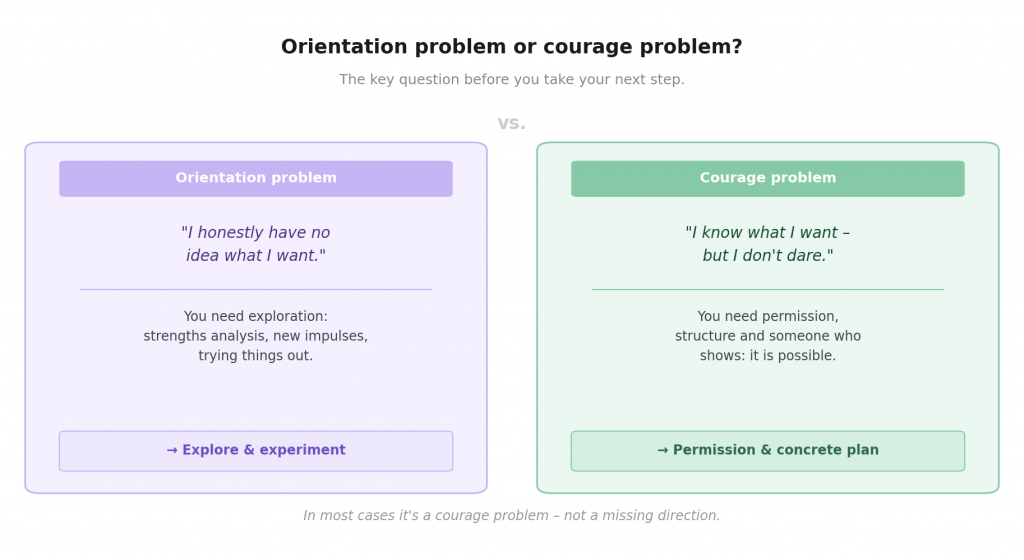
Many people say: “I don’t know what I want.” But when you look more closely, that’s often not true. They know – they just don’t dare to admit it.
Orientation problem
“I genuinely have no idea what I want.”
You need exploration: strengths analysis, new impulses, trying things out.
Courage problem
“I actually know what I want – but I don’t dare.”
You need permission, structure, and someone who shows you that it’s possible.
Strelecky calls this the Purpose of Existence – or POE. Not in a spiritual sense, but very concretely: the reason why you do what you do. And why you get up in the morning. Most people who say “I don’t know what I want” actually already know their POE. They just never had permission to take it seriously.
💡 In most cases, the problem is not a lack of orientation – but a lack of permission. Permission to take yourself seriously.
And here comes the uncomfortable part.
If you’ve sensed for some time what you actually want – but aren’t changing anything – then that’s not disorientation. It’s a decision. A decision to continue as before.
No one is forcing you to stay. You stay because a part of you currently considers it safer than the unknown. That’s human. But it’s also honest: whoever changes nothing has made a decision – just without admitting it.
Imagine it’s one year from now. You’re still in the same job. Same tasks. Same thoughts on Monday morning. Same tiredness on Friday evening.
What exactly has improved?
Take a moment. Not rhetorically – but really. What would have changed in a year if you do nothing today?
First Steps: Clarity Doesn’t Come from Thinking – It Comes from Acting
You don’t have to change everything at once. But you have to start – with small, concrete steps that give you real feedback.
Step 1 – Observe, Don’t Decide
Keep a simple log for a week: What gave me energy today? What took it away? The patterns reveal themselves.
Step 2 – Dare Mini-Experiments
Have a conversation with someone who works in an area that attracts you. No commitment – just curious exploration.
Step 3 – Get External Reflection
A coaching conversation or a strengths analysis often shows more than months of thinking alone. We can only see ourselves so clearly.
A client once said in our first conversation: “I spent three years thinking I just needed more time to think.” Three years. The same job every day, the same doubts every day, the same hope that clarity would somehow arrive on its own.
After one hour, it became clear to him: he had known the answer all along. He was just afraid to say it out loud – because that would have meant truly having to change something.
What phase are you currently in?
In Closing
Career change is not a moment of decision. It is a process of clarification – and it doesn't begin with the perfect answer, but with the honest question.
You don't need to know everything before you start. You just need to stop waiting for clarity to arrive on its own. It won't. It comes through movement.
If while reading this article you noticed that something resonated with you – that's not a coincidence. That's the part of you that has wanted to be heard for a long time. Not by a coach, not by an article. By yourself.
In a brief conversation, you'll find out whether you currently have an orientation problem or a courage problem – and what your next clear step is.
Book a free introductory conversation with Sasha now.
Frequently Asked Questions About Career Change
At what point should I seek professional support?
When you've had the feeling of being stuck for months but can't gain clarity despite thinking about it – that's the point. Seeking professional support doesn't mean you can't do it on your own. It means you shorten the process and proceed with greater confidence.
Do I have to quit my job before I know where I'm headed?
No – and that's one of the most common mistakes. Clarity comes through exploration, not through a big leap into the unknown. Most successful career changes begin alongside the current job: with small experiments, conversations, and targeted analysis.
How long does a career change take?
That depends on how clear you already are and how actively you shape the process. In coaching practice, initial clear directions often emerge after just 3–5 targeted sessions. A complete career change – including applications and entry – typically takes between 3 and 12 months.
What if I'm afraid of making the wrong decision?
This fear is normal – and it's a sign that the decision matters to you. But: there is no perfect decision, only an informed one. The more you explore and the clearer your self-image becomes, the smaller this fear will get. By the way, not making a decision is also a decision – and not a good one.
Can I use a training voucher (Bildungsgutschein) from the Federal Employment Agency for coaching if I am still employed?
Yes, in principle this is possible – but not automatically. The Federal Employment Agency (or the Jobcenter) can also approve a training voucher for employed individuals if certain conditions are met. The decisive factor is always whether the planned measure is classified as necessary and beneficial for your professional development.
Read more: Bildungsgutschein for Career Coaching: Your Complete Guide for 2026
Can I change careers if I'm already over 40 or 50?
Absolutely. Many of the most significant career changes happen precisely at this age – because you finally know what you no longer want, and you're brave enough to change it. Experience is not an obstacle, but an advantage on the path to a new role.
What is the difference between coaching and career counseling?
Career counseling gives you concrete recommendations: CV, job search, market analysis. Coaching helps you gain clarity about your goals, values, and blockages – so that you make the right decisions yourself. In the best coaching approach, both elements flow together.
Sasha Osypenko, the author of this article, supports people in their career transitions and helps them gain clarity about their professional goals, strengths, and next steps. Her focus is on guiding people out of stuck professional situations and helping them find a direction that truly aligns with their personality and values. In her work, she combines reflection, structure, and practical implementation so that inner dissatisfaction can turn into real career change.