Why Can’t I Get a Job in Germany – Even Though I Have Real Experience?
April 13, 2026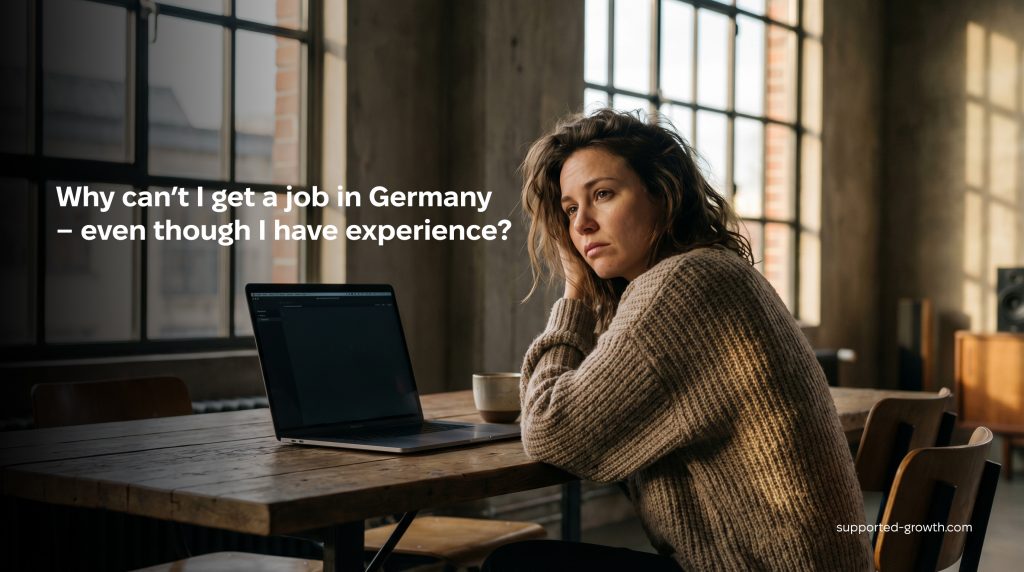
You open your inbox in the morning. Nothing. Or another automated rejection with no name, no reason, no indication of what went wrong.
You have five, ten, maybe fifteen years of professional experience. You’ve led projects, managed teams, delivered results. And still – silence.
At some point, a question creeps in that you haven’t quite said out loud: Is something wrong with me?
Almost always, the answer is no. The problem is somewhere else. And it has a name.
The German job application system works differently – and nobody tells you that
Germany has one of the most formalized hiring systems in the world. There are unwritten rules that feel completely natural to people who grew up here – and completely invisible to everyone else.
No employer will write in a rejection: “Your photo was missing” or “Your cover letter was too generic.” You just get silence. And you have no idea where to start.
Let’s go through the most common reasons. See if any of them sound familiar.
Your CV looks wrong to German HR eyes
Picture this: a recruiter opens your application. She spends about 30 seconds on the CV. No photo – already confused. Date ranges without months – a red flag. Two pages of dense paragraphs – she clicks away.
You’re out. Not because of your qualifications. Because of the format.
In Germany, a CV is expected to follow a very specific structure:
- A professional headshot – not a selfie, not a LinkedIn crop. A clean portrait against a neutral background. Yes, this is still standard in Germany
- Exact date ranges – not “2019–2021”, but “04/2019 – 11/2021”
- No unexplained gaps – every career break needs a short note: further education, relocation, parental leave
- Tabular layout, maximum 2 pages – no long prose descriptions, no skills paragraphs
- Reverse chronological order – your most recent job goes at the top
If your CV doesn’t follow these rules, it gets discarded before anyone reads a single line about your experience.
Your foreign degree officially doesn’t exist – as far as many employers are concerned
You studied. You have a degree. But in Germany, it’s not just about what you can do – it’s about what you can prove.
A university degree from Ukraine, Russia, Kazakhstan, or any non-EU country is not automatically recognized as equivalent. Recruiters see an unfamiliar university on your CV and quietly doubt – without telling you.
What to do:
- Check the Anabin database (anabin.kmk.org) – this is where German authorities rate foreign universities and degree programs by recognition status
- Apply for official recognition – through uni-assist, the KMK, or the relevant state authority, depending on your field
- Name the status in your application – “Degree currently in recognition process (KMK)” is far better than leaving it unexplained
Your language level and the job requirements don’t match
“Good German language skills required” – it says so in the job posting. But what does that actually mean in practice?
For most office roles: at least C1. If you’re at B2, you can communicate – but in daily professional life, the precision is often missing. In emails, meetings, complex negotiations. Employers notice immediately.
That sounds harsh. But it’s better to know now than to wonder after the twentieth rejection.
What helps:
- Filter by language requirement – many companies in tech, marketing, and international corporations work in English. Start there
- Don’t waste time on general language courses – invest in focused business German: writing emails, running presentations, handling calls
- Honest self-test – can you hold a 45-minute job interview in German without losing your footing? If not, you know where to start
Your cover letter lands in the bin before anyone reads it
In many countries, a cover letter is optional. In Germany, it often determines whether your CV gets opened at all.
And the most common cover letters arriving in German inboxes sound like this:
“I am a motivated and team-oriented professional with several years of experience and hereby apply for the advertised position…”
The recruiter reads this thirty times a week. It goes straight in the bin – along with everything attached to it.
A German cover letter answers three specific questions:
- Why this company – and not another one?
- Why this position – and not a similar one elsewhere?
- What can you specifically contribute – with numbers, projects, results?
If your cover letter can’t answer all three, it’s too generic.
Your work experience sounds abstract to German employers
“10 years in project management” – that sounds strong. But a German employer immediately thinks: which market? Which tools? What kind of organizational structure?
Experience from abroad isn’t worthless – it’s just not automatically understood. You have to translate it. Actively. Concretely.
What that means in practice:
- Name tools and standards that are known in Germany: SAP, DATEV, Scrum, PRINCE2, ISO norms – even if you only partially worked with them
- Explain the context of your results: “Team of 12, budget €500K, B2B market in Ukraine and Poland” – this makes your experience tangible
- Show market awareness – candidates who demonstrate they understand the German market feel like less of a risk to hire
You don’t have an Arbeitszeugnis – and that’s a real problem
The Arbeitszeugnis is a formal reference document that every German employer is legally required to issue at the end of an employment relationship. It’s not a recommendation letter. It’s a coded document with its own language. (Yes, really: “always to our complete satisfaction” means something very different from “to our satisfaction.”)
If you’re new to Germany, you simply don’t have one. That’s not your fault – but it’s a gap you need to actively close.
Concrete options:
- Get reference letters from previous employers abroad – have them translated professionally and formatted properly
- Build your first German work history – an internship, a freelance project, volunteer work. Even if it feels beneath your level: your first German reference opens doors
- LinkedIn recommendations – not an official substitute, but a visible trust signal for recruiters who find your profile
You’re searching the visible job market – but most jobs aren’t there
You’re checking StepStone, Indeed, LinkedIn Jobs. That’s not wrong. But estimates suggest up to 70% of positions in Germany are never publicly advertised.
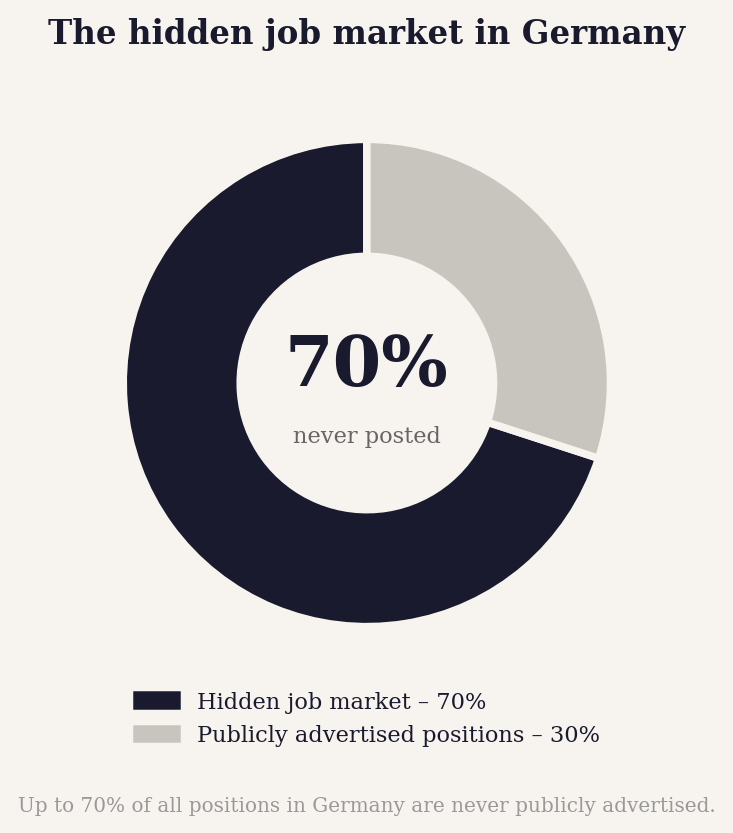
They’re filled through contacts. Through recommendations. Through what Germans call Vitamin B – connections.
If you’re new to the country, you don’t have that network yet. That’s not a personal failure – it’s a structural disadvantage. And the only way to overcome it is to build deliberately.
What actually helps:
- Rewrite your LinkedIn headline – not just your job title, but a line that makes recruiters find you in search. Instead of “Marketing Manager”: “Marketing Manager | SEO & Performance | DACH market | open to new opportunities”
- One real contact per week – not applications, but people: recruiters, former colleagues, alumni. No pitch. Just a genuine conversation
- Reach out to target companies directly – an unsolicited application often lands on someone’s desk before the role is even posted
You get the interview – and then something goes wrong that nobody explains
The conversation felt fine, you thought. Two weeks later, the rejection arrives. No feedback, of course.
German job interviews have their own invisible rules:
- Punctuality is non-negotiable – 5 minutes early is the standard. Being even 2 minutes late leaves an impression that’s nearly impossible to undo
- Self-presentation ≠ self-promotion – in many cultures, showing your strength loudly is expected. In Germany, too much self-marketing reads as arrogance. The tone should be calm, factual, backed by specific examples
- Preparation is obvious – “What do you know about our company?” is not a warm-up question. Vague answers end interviews
- Structured responses are valued – the STAR method (Situation, Task, Action, Result) is standard in German interviews. Practice shaping your answers in this format
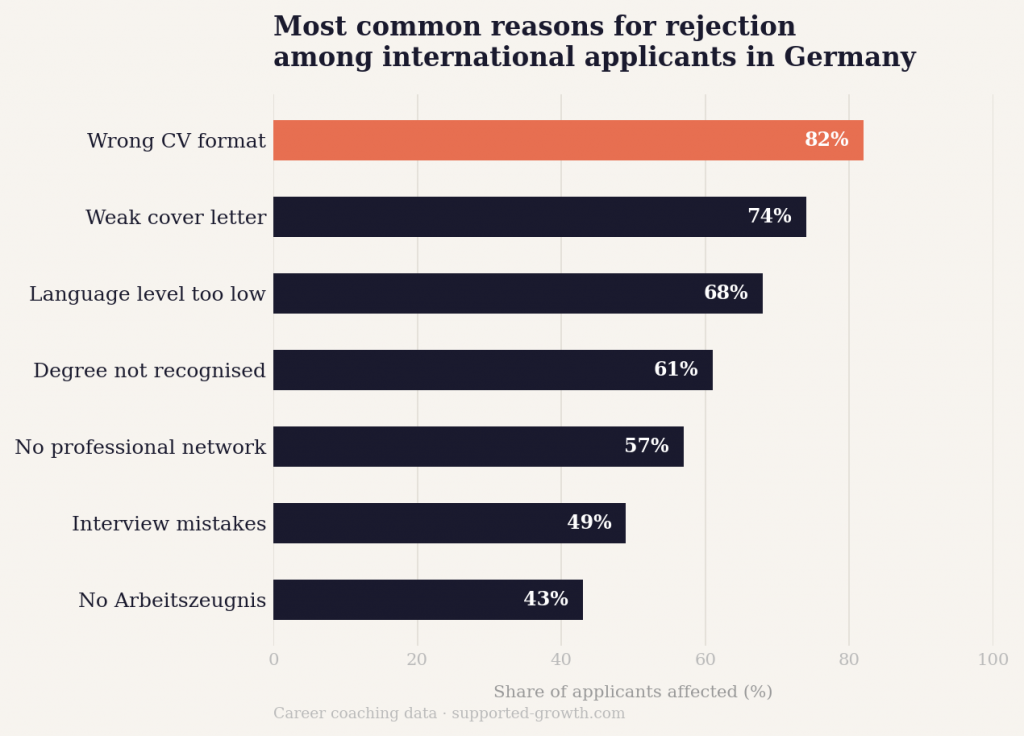
What you can do right now – step by step
If you recognized yourself in one or more of these points: that’s actually good news. It means the problem has a name – and a solution.
Step 1 – Audit your CV
Open it now. Is there a photo? Are all date ranges listed with months? Are there any unexplained gaps? If yes: start here, before anything else.
Step 2 – Check your degree
Go to anabin.kmk.org, search your university and degree program, note the recognition status. If it’s unclear: request a free recognition consultation through Make it in Germany or the IQ network.
Step 3 – Be honest about your language level
Not the level on your certificate – the level in a real conversation. Filter your job search accordingly: if you’re at B2, prioritize English-language roles first.
Step 4 – Rewrite one cover letter completely
Not all of them – just one. Find out what this specific company actually needs. Write three sentences that could only apply to this role. If you could send the same sentences somewhere else, start over.
Step 5 – Change your LinkedIn headline today
Right now. Add your core competencies, target market, and openness to new opportunities behind your job title. This takes 10 minutes and immediately increases your visibility to recruiters.
Step 6 – Make one real connection this week
Not an application. A person. A recruiter, an alumni, someone in your field. No sales pitch. A real question or a real conversation.

Self-check: where exactly is it stalling?
Why isn’t your job search working?
Be honest – the more accurate your answers, the more useful the result.
If you want, we can look at your application together
You’ll get honest feedback – even if it’s uncomfortable. Not because something is wrong with you, but because this system has rules that nobody says out loud.
That’s exactly what we work on in coaching.
No motivational talk. No generic advice. We look at what you actually have – your CV, cover letter, LinkedIn profile – and find exactly where the problem is.
Frequently Asked Questions
How long does the job search in Germany typically take for foreigners?
It depends heavily on your field, language level, and how targeted your strategy is. Without a clear approach, the search often takes 6 to 18 months. With an optimized application strategy and active networking, that window can shrink to 2 to 4 months.
Do I really need a photo on my CV in Germany?
Yes. A professional headshot is still standard in Germany and expected by most employers. Not a selfie, not a LinkedIn crop – a clean portrait, ideally taken by a photographer.
My degree isn’t in the Anabin database – what now?
If your degree isn’t listed, you can request an individual assessment from the Central Office for Foreign Education (ZAB). For regulated professions (doctor, engineer, teacher), there are additional recognition authorities at the state level. Free advisory services are available through the IQ Network Germany.
Does my cover letter have to be in German?
Generally yes – unless the job posting is in English, or the company specifies that English is the working language. Important: a German cover letter with grammar mistakes can make a worse impression than an excellent English one. Have it proofread by a native speaker before sending.
What is the hidden job market and how do I access it?
The hidden job market refers to positions that are never publicly advertised – estimates put this at up to 70% of all open roles. Access runs almost entirely through personal networks: LinkedIn contacts, recruiters, direct outreach, and industry events. If you’re only searching on job portals, you’re seeing a fraction of what’s available.
Is it worth applying to German-language roles with B2 German?
It depends on the role. Technical positions and jobs at international companies are often accessible with B2. Roles with heavy client contact, in public administration, or at management level typically require C1 or higher. An honest self-assessment and smarter filtering will take you further than sending more applications.
Is career coaching actually worth it?
Coaching isn’t a guarantee. But it shortens the path – because you don’t have to figure out on your own what’s going wrong. A good coach looks at what you concretely have and tells you directly where the problem is. That often saves months.
This article was written by Sasha Osypenko – career coach for internationally experienced professionals navigating the German job market.