You’re Not Writing a Resume – You’re Evaluating Yourself
April 17, 2026Why writing a resume costs so much energy – and what’s really behind it
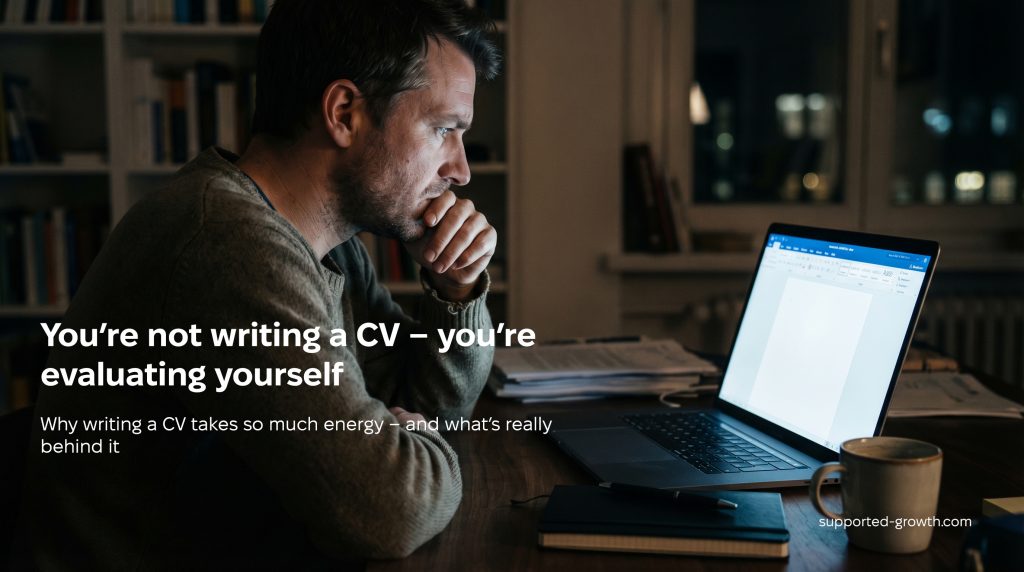
You open the file. Maybe it’s called “Resume_final.docx” – or “Resume_new_2022” – or simply “CV.”
You read the first line. And then something strange happens: a faint discomfort spreads through you. Not pain, not shock – but something close to shame. Did I really describe myself that way? That’s no way to sell yourself.
You close the file.
A week later, you open it again.
In the meantime, you’ve been on LinkedIn. You’ve seen profiles of people you barely know – but somehow they all have a clear positioning, impressive career milestones, phrasing that makes you think: How do they come up with that? And suddenly you appear smaller in your own eyes than you did before.
This isn’t an isolated case. It’s a pattern. And it has little to do with your resume.
Why an empty document is so hard to fill
A resume feels harmless – one page, two pages, a bit of formatting. But what you’re actually doing there is something else: you’re evaluating yourself. Publicly. For strangers who will decide within seconds whether you’re interesting enough to keep reading.
No wonder it creates a block. According to a survey of over 2,000 professionals, 93% have experienced anxiety before a job interview – and that’s only the last step in the application process. Before that comes the resume. And before that comes the blank document.
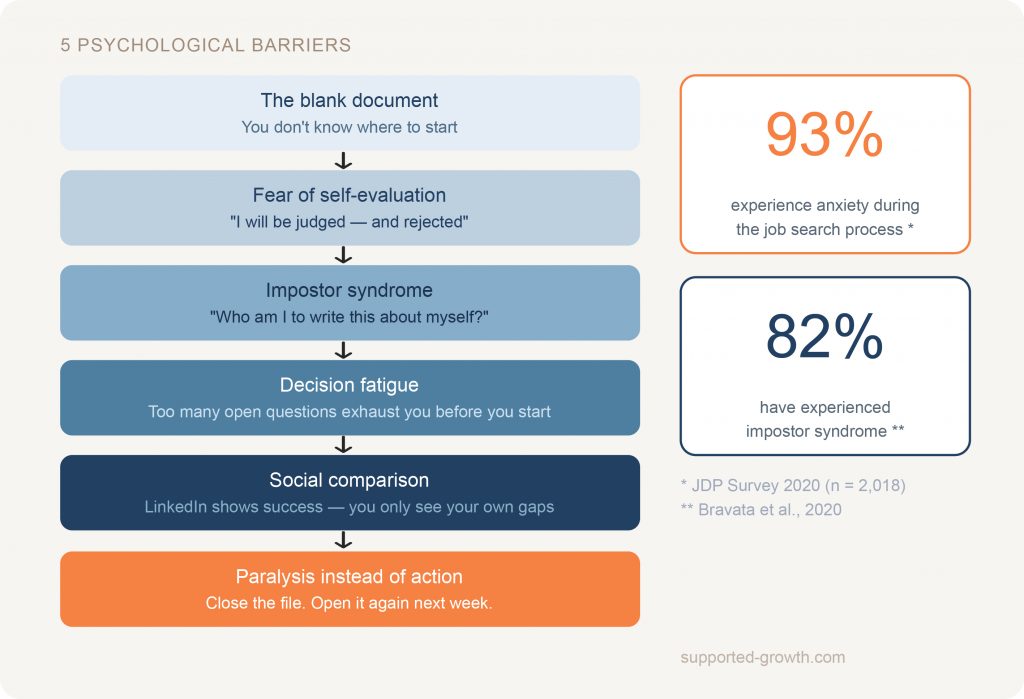
From a psychological standpoint, here’s what happens when you write a resume: the brain doesn’t interpret this task as “create text,” but as “expose myself to rejection.” Psychiatrist Judson Brewer puts it plainly: “Our brain loves predictability. The moment the future becomes uncertain, panic sets in.” And a resume is the embodiment of that uncertainty – you don’t know how it will be received.
On top of that comes the so-called Impostor Syndrome: the feeling of not being good enough to put your own experience into words. Who am I to phrase it like that? Doesn’t it sound exaggerated? This is not a personal weakness – it’s a widespread phenomenon. Studies show that up to 82% of professionals experience such feelings: self-doubt, fear of being exposed as a “fraud,” the sense of not having deserved one’s own success. Paradoxically, people with a lot of experience are especially prone to this.
Even before you write the first line, you exhaust yourself with decisions: Which format? What order? What wording? This is Decision Fatigue – cognitive exhaustion from too many open questions at once. The result: you do nothing at all.
And then there’s the comparison. LinkedIn and Xing are not neutral platforms – they are showcases of other people’s best selves. You don’t see insecurities, gaps, or bad phases. You see curated success. And you measure your unfinished interior against their polished exterior. A 2023 study published in the journal Psychology & Marketing examined this connection empirically for the first time: people who regularly use professional networks like LinkedIn are more likely to develop impostor thoughts – especially when they are going through a period of uncertainty themselves. The result is paralysis, not motivation.
If you haven’t been job-hunting for a long time, there’s another layer added: the feeling that the market has changed – and that somehow you haven’t kept up. Everyone’s talking about AI, personal branding, soft skills – what’s supposed to go in now?
Why AI doesn’t solve the problem – it just shifts it
At some point comes the moment when you think: I’ll just have ChatGPT write it.
Understandable. Even clever, at first glance.
But here lies a trap that barely anyone talks about: AI creates the illusion of progress.
You enter a few keywords. A text appears. You read through it, change a few sentences, save the file. Done. Box checked, tab closed.
But what really happened? The text sounds like no one. It describes a person who could roughly be you – but isn’t really you. You know this. And so you don’t send it. Or you do send it – and get no response – and don’t know why.
The real problem isn’t the document. It’s the question behind it: Who am I in the job market, and what do I actually want? No language model can answer that. AI can formulate – but it can’t figure out what you’re worth and where you want to go. That’s human work.
The LinkedIn trick: why it’s easier there
Interestingly, many people have fewer inhibitions maintaining their LinkedIn profile than writing a resume. Why?
Because LinkedIn never feels final. It’s a living document – you can change, add to, or correct it at any time. No “now it’s being sent and that’s that.” This openness takes away the pressure.
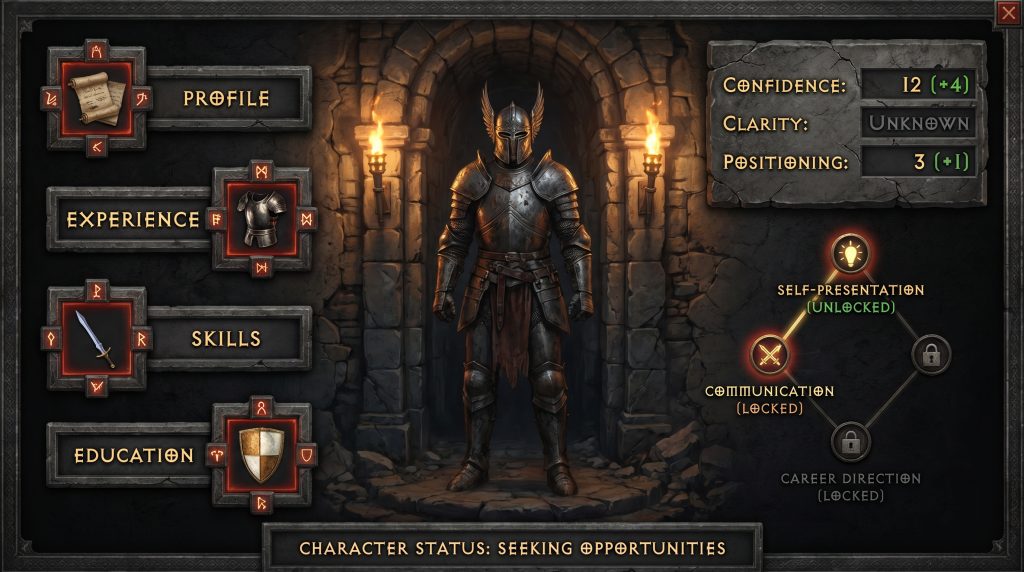
There’s also something that behavioral psychologists know well: gamification. Every completed section brings you closer to a full profile. There’s a progress bar. It feels like leveling up a character in a role-playing game – every new skill unlocked, every position entered: +10 experience points.
You can apply this mechanic directly to your resume. Not “I’m writing my resume now” – but: I’m unlocking a section.
And if you do nothing else today: write one single sentence. What did you actually accomplish in your last role? Not what your tasks were – what you achieved. Or just update your LinkedIn headline. One small step is enough to break the spell.
One resume isn’t enough – and why that’s actually good news
Now many people think: Fine, I’ll do it. I’ll write a solid resume – and then it’s done.
That sounds reasonable. But it’s an illusion.
In today’s job market, most applications are filtered by an algorithm first – not a human. ATS systems (Applicant Tracking Systems) scan resumes for specific keywords that vary completely depending on the position and industry. What works for a startup won’t make it past a corporation. What impresses in IT sounds wrong in marketing.
That means: you need multiple versions of your resume. Tailored to the role, the company, the industry.
That sounds like more work at first – and yes, it is more work. But it’s a completely different feeling when you see it as a system, not chaos:
| A universal resume | A system of versions |
|---|---|
| Constant second-guessing: Does this even fit? | Clear hypotheses: Version A for startups, B for corporations |
| After every rejection: confusion | After every rejection: data. What didn’t work? |
| Feeling of helplessness | Feeling of control |
Writing one resume and sending it everywhere is like running a single ad for all target audiences – and hoping it somehow works. Real marketing works differently: test, adjust, optimize.
What a career coach really does – and what it does to you
A career coach doesn’t write your resume for you. That would be too easy – and wouldn’t solve the actual problem.
What happens instead: before any document is even opened, there’s an inventory. What have you done? What of it carries real weight? What do you want next – and why?
Many people come in saying: “I don’t really have anything special to show – it was all pretty much routine.”
A real-life example: a client who had been with the same company for ten years was convinced his profile was too unremarkable for a serious application. In conversation, it turned out: he had coordinated a team of seven people for over three years, fundamentally restructured two internal processes, and managed a project with a budget of over €400,000. He simply hadn’t classified any of that as “special” – because for him, it was just everyday work.
That’s the problem with the view from inside. You can no longer see what you have – because you’ve had it for too long.
A coach sees that. And can translate it into language that gets heard in the job market – without it feeling like bragging.
At the same time, a system takes shape: which versions of the resume do I need? How do I adapt them? How do I evaluate what’s working? From chaos comes strategy.
One question to close with
How long has your resume been sitting unfinished on your desktop?
A week? A month? A year?
Perhaps the problem isn’t the resume at all.
If you recognize the feeling of knowing what you can do – but not knowing how to show it: that’s the right moment for a first conversation. No pressure, no obligation – just clarity about where you stand and where you want to go.
Frequently Asked Questions About Resumes and Applications
How long should a resume be?
In Germany, the standard is: one page for entry-level candidates, two pages for everyone else. More than two pages is rarely read in full. More important than length is relevance – every line should have a reason to be there.
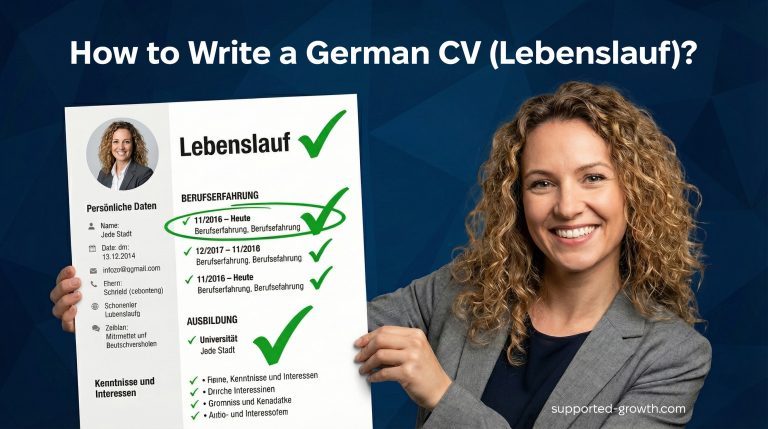
Read the full article: How to Write a German CV (Lebenslauf), That Actually Gets You Interviews
Do I really need to write multiple versions of my resume?
If you’re applying for very similar positions, one base version with small adjustments often suffices. But if you’re looking across different industries or roles, genuine differentiation pays off. Not because it’s required – but because a tailored resume simply has a higher response rate.
What do I do about gaps in my resume?
Gaps aren’t a problem – missing explanations are. Parental leave, further education, illness, a period of reorientation: all of these can be framed honestly and professionally. What you shouldn’t do is hide gaps or rephrase them so awkwardly that it seems implausible. Recruiters read resumes every day – they notice.
Can I use AI to write my resume?
As a tool: yes. As a substitute for your own clarity: no. AI can help you sharpen phrasing, check structure, or flesh out bullet points. But it can’t know what truly matters to you, where you want to go, or what sets you apart from others. You need to know that yourself first – otherwise you just quickly produce something that doesn’t feel like you.
Do I still need a cover letter today?
It depends heavily on the industry and company. Many employers in Germany still expect one – especially in the public sector, conservative industries, or when the job posting explicitly requests it. Startups and international companies often do without. If in doubt: better to write one than not – but please, no template text.
How long does it take to write a good resume?
Longer than you think – but not because of the writing itself. The real time investment lies in the thinking: What belongs in here? How do I phrase that? Which achievements are relevant? Anyone who thinks this through in a structured way beforehand – for example in a coaching conversation – writes much faster afterward and with far fewer blocks.
Sasha Osypenko is a career and integration coach with over 1,300 coaching hours and more than 10 years of experience in the corporate world – including as a Scrum Master and Agile Coach at Germany’s largest company. Her own story includes two major career changes: from journalism to IT, and finally into self-employment as a coach.
Sasha works exclusively online, in three languages (German, English, Ukrainian), and supports people in finding their professional direction, strengthening their application materials, and taking the next step with clarity. She is a member of the International Coaching Federation (ICF).